


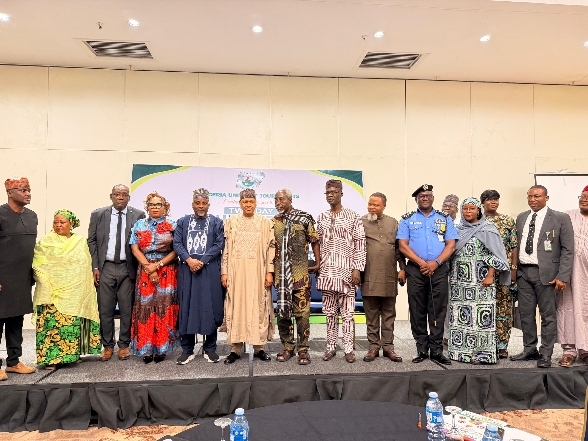
Delegates at the Nigeria Union of Journalists (NUJ) National Security Summit declared on Friday that press freedom and national security are mutually reinforcing and must be balanced within legal and ethical frameworks.
The two-day summit, held in Abuja from 18–19 June 2026 under the theme “Media and Security Agencies as Partners in Nation Building,” was organised by the NUJ in collaboration with the Department of State Services (DSS).
It drew media executives, journalists, heads of security and intelligence agencies, government officials, academics, civil society groups and development partners.
NUJ National President Alhassan Yahaya Abdullahi described the meeting as a timely response to Nigeria’s range of security challenges — from terrorism, banditry and kidnapping to cybercrime, misinformation and separatist agitations — and stressed that national security is a shared responsibility requiring coordinated action and ethical reporting.
The chairman of the occasion and Information Minister, Mohammed Idris, urged strengthened trust and strategic communication between media and security agencies, while reiterating the Federal Government’s commitment to intelligence-driven operations, inter-agency collaboration, technological upgrades and community-based approaches to insecurity.
Speakers framed the media as a “force multiplier” for security operations and national development. Professor Okey Ikechukwu said public understanding and cooperation are central to operational legitimacy, while Musikilu Mojeed, president of the International Press Institute (IPI) Nigeria, argued tensions between press freedom and security should be managed through dialogue, professional accountability and due process — not coercion.
The summit also highlighted the role of women in peacebuilding. Aisha Ibrahim of the Nigeria Association of Women Journalists called for greater inclusion of women in security governance and early-warning systems.
A key moment was NUJ’s investiture of DSS Director-General Adeola Oluwatosin Ajayi, in recognition of his efforts to foster engagement and collaboration between the service and media stakeholders.
Participants listed core observations, including the complexity of Nigeria’s security landscape, the threat of misinformation to public trust, the need for whole-of-society responses, and the under‑utilisation of women and youth in peacebuilding. They warned that socio-economic drivers such as unemployment and drug abuse fuel criminality and instability.
The summit adopted several recommendations: establish institutionalised dialogue channels between media and security agencies; enforce proactive, transparent communication by security bodies; bolster media fact‑checking and ethics; resolve disputes through legal and professional mechanisms; run joint training for journalists and security communicators; scale up social investments and gender inclusion; formalise community‑based early warning systems; intensify anti‑drug campaigns; and integrate summit outcomes into national security and communication frameworks.
Organisers also urged increased funding for security agencies and better resourcing for state‑owned media while emphasising editorial independence.
The communiqué, signed by NUJ President Abdullahi on 19 June 2026, thanked DSS leadership for partnering on the summit and concluded that sustainable peace and development hinge on trust, transparency, constitutionalism and accountability.
