


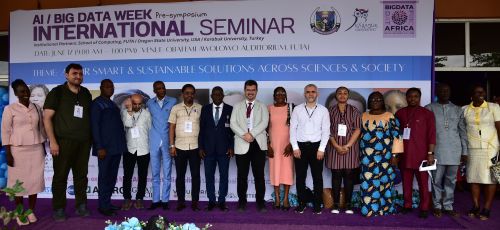
Experts at the 5th African Symposium on Big Data, Analytics and Machine Intelligence (held alongside the 22nd TYAN International Thematic Workshop) at the Federal University of Technology Akure (FUTA) have called for accelerated use of artificial intelligence (AI), satellite imagery and other digital tools to build safer cities and deliver sustainable solutions to pressing social challenges.
The symposium, held from June 15–20, 2026, under the theme “AI for Smart and Sustainable Solutions Across Sciences and Societies,” gathered academics and practitioners from Nigeria, Turkey, Tanzania, Egypt, Singapore, the United States, the United Kingdom, Australia, the Democratic Republic of Congo and Tunisia.
In a keynote titled “AI for Smart and Sustainable Systems,” Vice-Rector of Karabük University, Professor Rakip Karas, demonstrated practical applications of AI and geospatial mapping. He showed how AI-driven systems can guide people to safety during emergencies, optimise traffic flow and parking, predict forest fires before they spread, and detect buildings and roads from satellite images. Karas also highlighted real-time medical uses, including detecting parasites in samples via image analysis.
“By combining data from sensors, satellites and digital maps, cities can make better decisions on transportation, disaster response, infrastructure planning and public health,” Karas said, adding that these technologies are already being tested in real-world settings and significantly boost urban resilience and quality of life.
Turkish scholar Dr. Caner Ozcan, speaking on “Machine Learning across Disciplines,” described big data as the fuel and machine learning as the engine that converts it into actionable insight. He said modern AI integrates big data, machine learning and deep learning to interpret complex visual and audio data, with computer vision applied to X-rays, satellite imagery and other diagnostics. Ozcan stressed the need to build AI literacy among educators so future generations can develop and use these tools responsibly.
Representing FUTA’s Vice-Chancellor, Professor Adenike Oladiji, Deputy Vice-Chancellor (Development) Professor Sunday Oluyamo said data has become one of the world’s most valuable resources. He noted AI’s transformative role across security, agriculture, education, finance, governance, environmental management and industry, but warned that technology alone is insufficient. “The challenge for Africa and the Global South is ensuring these technologies are developed and deployed responsibly, inclusively and sustainably,” he said, urging investment in indigenous capacity, digital infrastructure and ethical AI practices.
FUTA’s Dean of the School of Computing, Professor Boniface Alese, said AI is already delivering tangible benefits in healthcare, agriculture and language technologies tailored to African contexts — including models for Yoruba, Igbo and Hausa. He warned that without local infrastructure and skills, Africa risks becoming a consumer of externally trained systems that do not reflect local realities.
Professor Emile Chimusa of Northumbria University addressed advances in bioinformatics, noting that the integration of biology, computer science and AI is rapidly reshaping African health sciences. Meanwhile, Professor Dennis Mwighusa, Executive Director of the African Research Institute of AI in Tanzania, urged that AI for sustainable development must be African-led and grounded in local data, with strong governance to ensure real-world impact.
Organising chair Professor Bolanle Ojokoh highlighted the symposium’s role in fostering interdisciplinary collaboration and mentoring graduate students. She praised FUTA’s leadership for promoting research excellence and international partnerships through the TYAN workshop series.
The week-long event showcased research, workshops and cross-border partnerships with institutions including Oregon Institute of Technology (USA), Karabük University (Turkey) and The World Academy of Sciences’ Young Affiliates Network. Delegates agreed that positioning data and AI at the center of research and policy will be critical to solving real-world problems across Africa and the Global South.
