


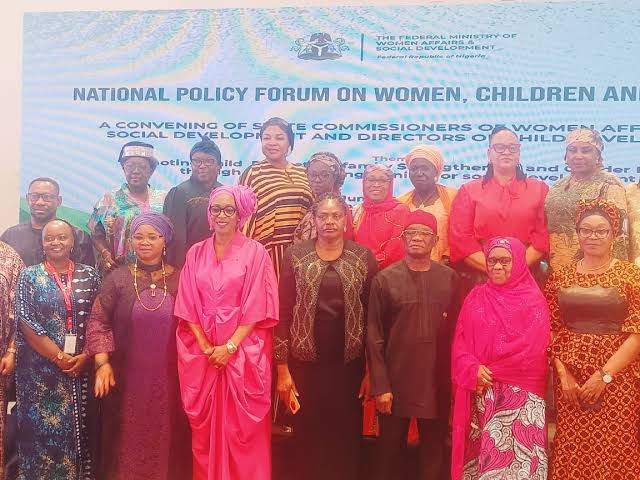
The Federal Government says strengthening families has become critical to protecting children from emerging threats and improving welfare outcomes across the country amid evolving social and economic challenges.
Mrs. Esuabana Nko-Asanye, Permanent Secretary of the Federal Ministry of Women Affairs, made this statement on Monday at the National Policy Forum on Women, Children, and Families in Abuja.
Nko-Asanye stated that the government is reviewing key child protection and family welfare policies to ensure they remain relevant and responsive to changing social realities nationwide.
She explained that the review covers Nigeria’s outstanding periodic reports to international bodies and strategic policy documents affecting women, children, and other vulnerable groups across the country.
According to her, the outcomes of the review will be implemented at state and local government levels to strengthen family support systems and improve protection for children.
“The realities confronting children and families continue to evolve, making it necessary for policies and programs to adapt accordingly,” she said.
Also speaking, the Director-General of the Maryam Babangida National Centre for Women Development, Dr. Adedayo Benjamins-Laniyi, stated that sustainable child protection begins with stronger families and communities.
Benjamins-Laniyi noted that child welfare issues now extend beyond legal and policy frameworks to include education, healthcare, nutrition, digital security, and social protection concerns.
She warned that child trafficking has become one of the most lucrative forms of organized crime globally, requiring stronger collaboration among governments, communities, and development partners.
“Children’s issues are no longer sectoral; they involve education, health, nutrition, digital security, and community protection,” she said, advocating for integrated child welfare interventions.
“Child trafficking is one of the highest-gain crimes today, which is why governments must continue to strengthen social protection and child welfare systems,” she added.
According to her, family-centered interventions are essential to addressing vulnerabilities affecting children and at-risk groups, while promoting resilience, inclusion, and long-term social stability.
She emphasized that policy reforms and stronger social institutions are necessary to respond effectively to emerging threats and ensure children receive adequate care and protection.
Earlier, Dr. Mac-John Nwobiala, Co-Chairman of the National Child Rights Implementation Committee, stated that Nigeria must continually strengthen child protection systems to reflect changing realities.
Nwobiala stressed that existing frameworks, including the National Child Policy approved in 2007, require updating to address contemporary challenges affecting children and families nationwide.
He highlighted the need for stronger safeguarding mechanisms in schools, improved access to education, and responsible use of digital platforms by children and young people.
“Society is dynamic. A lot has changed, and a lot is happening to our children. We need stronger systems to protect them and ensure their rights remain a national priority,” he said.
Additionally, Plateau State Commissioner for Women Affairs and Social Development, Mrs. Caroline Dafur, said the forum would help states improve interventions for vulnerable children nationwide.
Dafur emphasized that particular attention is needed for children living in orphanages and displacement settings, where vulnerabilities often require specialized support and protection services.
She expressed optimism that lessons from the forum would strengthen child welfare systems and support the reintegration of vulnerable children into communities across Nigeria.
The forum was organized by the Federal Ministry of Women Affairs to review Nigeria’s periodic reports to international bodies and validate strategic policy documents.
