


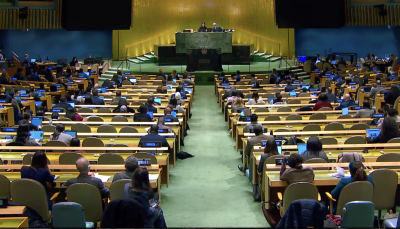
The United Nations General Assembly has overwhelmingly adopted a landmark political declaration aimed at tackling non-communicable diseases (NCDs) and promoting mental health, with 175 member states voting in favour. Only the United States and Argentina opposed the declaration, while Paraguay abstained.
The declaration was originally scheduled for adoption by consensus at the UN High-Level Meeting (HLM) on NCDs on September 25. However, last-minute objections by the United States forced the matter to be referred to the General Assembly for a formal vote.
A first-ever joint global framework
Welcoming the outcome, the World Health Organization (WHO) described the declaration as the first global political framework to address NCDs and mental health together.
“This marks a unique opportunity to accelerate global progress, with specific and measurable targets set for 2030,” the WHO said in a statement.
For the first time, governments have agreed to three global outcome targets by 2030:
- 150 million fewer tobacco users
- 150 million more people with hypertension under control
- 150 million more people with access to mental health care
The declaration also establishes ambitious process targets, including:
- At least 80% of countries are implementing policy, legislative, regulatory, and fiscal measures on NCDs and mental health
- 80% of primary health care facilities stocked with essential medicines and basic technologies
- 60% of countries are adopting measures to reduce or cap the cost of essential NCD and mental health services
A growing global health and economic threat
Non-communicable diseases cause an estimated 18 million premature deaths each year, while mental health conditions affect more than one billion people worldwide.
According to the WHO, NCDs are largely driven by preventable risk factors such as unhealthy diets, tobacco use, harmful alcohol consumption, physical inactivity, and air pollution—many of which also undermine mental health.
“These conditions are rising in every country and every community, making them not just a public health emergency but also a threat to productivity and sustainable economic growth,” the agency said.
The NCD Alliance (NCDA) described the declaration as “a significant milestone for the global NCD agenda,” noting that it introduces action-oriented targets to accelerate prevention, care, and investment.
However, the alliance expressed regret that procedural objections by a small number of countries delayed its adoption.
“Implementation must now be swift, sustained, and backed with adequate resources,” said Alison Cox, NCDA’s Director of Policy and Advocacy.
US objections and controversy
Speaking at the September HLM, US Health and Human Services Secretary Robert F. Kennedy Jr. argued that the declaration went too far, particularly in recommending fiscal measures such as taxes on unhealthy products.
In practice, the declaration only urges countries to consider introducing or increasing taxes on tobacco and alcohol, in line with national circumstances, to support public health goals.
Kennedy also claimed the US could not accept language promoting what he termed “destructive gender ideology” or implying a right to abortion. However, the declaration does not mention abortion. Its reference to sexual and reproductive health relates to integrating NCD services, particularly for conditions such as cervical cancer, which is preventable and treatable if detected early.
On gender, the declaration calls for “mainstreaming a gender perspective” to better understand differing health risks and needs. Data show women are more likely to be obese, while men face higher rates of NCDs such as liver and lung cancer.
Access to medicines and care
Médecins Sans Frontières (MSF) welcomed the declaration’s recognition of access to affordable health products as central to addressing diabetes, mental health conditions, and cervical cancer.
However, MSF stressed that low- and middle-income countries need concrete action to improve access to essential medical tools.
“This means affordable and sustainable access to insulin pens and glucose monitoring tools for people with diabetes, long-acting antipsychotics and other essential medicines for mental health conditions, and HPV vaccination and cervical cancer screening,” MSF said. Patients with cervical cancer must also have access to quality chemotherapy and other treatments.
Hypertension, alcohol, and tobacco
Borjana Pervan, Chief Operating Officer of the World Heart Federation, urged governments to commit to achieving 50% global hypertension control by scaling up access to affordable medicines for 500 million more people by 2030.
“This alone could prevent at least 75 million deaths by 2050 and generate net economic gains of $212 billion annually,” she said, adding that stronger fiscal policies on alcohol, tobacco, and sugar-sweetened beverages are critical.
Air pollution: A missing target
The Clean Air Fund (CAF) noted that while the declaration recognises air pollution as a major driver of NCDs, it stops short of endorsing the WHO’s existing target to halve air-pollution-related deaths.
“Air pollution now causes around eight million deaths annually—more than tobacco,” said Nina Renshaw, CAF’s Head of Health. She noted that a WHO-endorsed target adopted by health ministers in May 2025 aims to halve deaths linked to human-made air pollution by 2040, potentially preventing three to four million deaths each year.
