


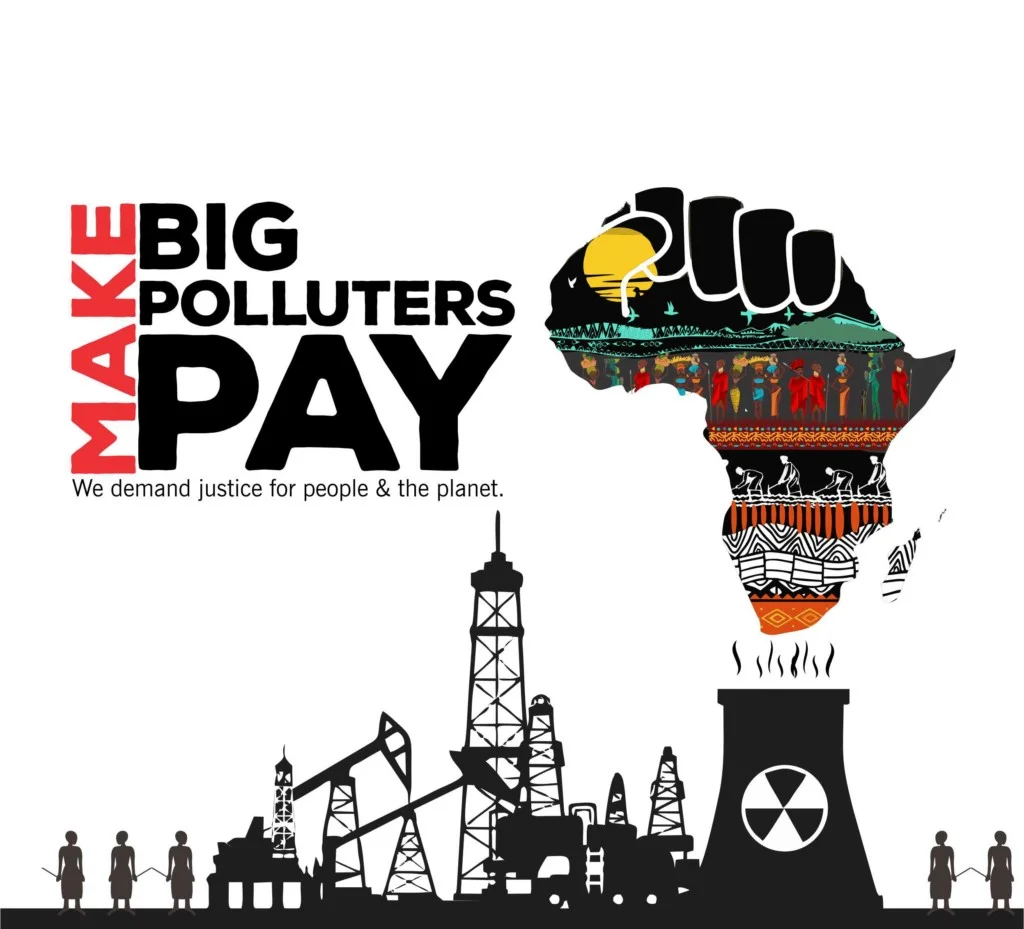
The Africa Make Big Polluters Pay (MBPP) Coalition has rejected the newly inaugurated Tropical Forest Forever Facility (TFFF), describing it as a dangerous and misleading attempt to financial nature under the guise of protecting it.
The coalition’s position was contained in a statement by Robert Egbe, Media and Communication Officer at Corporate Accountability and Public Participation Africa (CAPPA), on Monday in Abuja.
Egbe said the group opposed the TFFF, launched at the ongoing United Nations Climate Change Conference (COP30) in Belém, Brazil. The Africa MBPP, made up of more than 32 organizations including CAPPA, Gender CC Southern Africa, the Global Forest Coalition (GFC) and others across the continent, is committed to holding polluting corporations accountable for their role in driving the climate crisis.
Spearheaded by Brazil, the TFFF is being promoted as a 125-billion-dollar blended-finance fund promising annual payments to countries for protecting and maintaining their forests. However, the coalition argued that the facility—widely marketed as an innovative climate-finance tool—offers no real support to climate-vulnerable nations.
It warned that the initiative reduces tropical forests to “tradable assets” controlled by powerful financial institutions, thereby reinforcing the same extractive systems responsible for deforestation, exploitation and inequality.
“The excitement that has trailed the launch of the TFFF is misplaced,” the coalition said.
“Rather than safeguarding forests, it commodifies living ecosystems, undermines Indigenous and community-led stewardship, and erodes the principles of climate justice it claims to uphold.”
The group said the facility poses serious risks to Africa, home to some of the world’s most biodiverse forests and climate-vulnerable communities.
“Instead of empowering African nations, the facility risks tightening financial dependence and eroding local sovereignty over forest resources,” it said.
It noted that countries including Nigeria, Angola, Benin, Cameroon, Côte d’Ivoire, Equatorial Guinea, Ghana, Liberia, Mozambique, Rwanda, Sierra Leone, Togo and Uganda were being drawn into a system that places investor returns above community needs.
“What it offers is not real climate finance, but new layers of external bureaucracy and financial engineering,” the coalition added.
It condemned the TFFF’s model in which investor obligations are prioritized before any payments reach countries, warning that this approach deepens corporate influence while excluding frontline communities whose stewardship has long protected biodiversity.
The coalition described the proposed four-dollar-per-hectare annual payment for standing forests as “tokenism,” given the ecological, cultural and economic value of tropical forests and the cost of community-led protection.
“Far from advancing the Paris Agreement or Africa’s restoration goals, the TFFF threatens to divert attention and resources away from genuine, community-led climate actions towards opaque financial schemes,” it said.
The group also criticized the decision to appoint the World Bank as trustee of the facility, calling it a regressive and exclusionary move that undermines local ownership and accountability.
“Experience has shown that World Bank-led climate finance centralizes power, delays funding and silences frontline communities, making the TFFF another bureaucratic obstacle rather than a climate solution,” it said.
Akinbode Oluwafemi, Executive Director of CAPPA, said: “Accountability in climate finance starts with rejecting corporate capture. The World Bank must not be allowed to turn forest protection into another business model.”
Mokoena Ndivile of Gender CC Southern Africa said forest preservation is tied to the survival, dignity and livelihoods of communities, especially women, and must not be turned into an instrument of financial control.
Similarly, Kwami Kpondzo of the Global Forest Coalition warned that World Bank involvement would marginalize Indigenous knowledge and prioritize corporate profit over community needs.
The coalition insisted that the TFFF’s governance structure fails to represent or prioritize the Global South and is designed to serve financiers rather than forest peoples.
It urged world leaders to reject the facility and instead support transparent, community-led climate-finance systems that strengthen local control and environmental justice.
