

• Home
  • Agric
  • Sci & Tech
  • Health
  • Environment
  • Hausa News
  • More
    • Business/Banking & Finance
    • POLITICS
    • Entertainments & Sports
    • International
    • Investigation
    • Law & Human Rights
    • Africa
    • ACCOUNTABILITY/CORRUPTION
    • Hassan Gimba
    • Column
    • Prof. Jibrin Ibrahim
    • Prof. M.K. Othman
    • Defense/Security
    • Education
    • Energy/Electricity
    • Entertainment/Arts & Sports
    • Society and Lifestyle
    • Food & Agriculture
    • Health & Healthy Living
    • International News
    • Interviews
    • Investigation/Fact-Check
    • LAW & HUMAN RIGHTS
    • Oil & Gas/Mineral Resources
    • PRESS FREEDOM/JOURNALISM/PR
    • General News
    • Presidency
  • About Us
    • Contact Us
    • Board Of Advisory
    • Privacy Policy
    • Ethics Policy
    • Teamwork And Collaboration Policy
    • Fact-Checking Policy
    • Advertising
  • Media OutReach Newswire
    • Wire News
  • The Stories
Facebook Twitter Instagram
Trending
  • Nasarawa assembly passes health, court bills
  • NERC launches net billing regulations 2026
  • Association urges investment in Ebonyi rice sector
  • Alake warns against attacks on NSCDC mining marshals
  • For how long will threats of Northerners, Muslims’ eviction from Yoruba land continue?
  • FCTA distributes 48 vein-finding devices to hospitals
  • Niger Assembly approves $14.4m loan to finance Niger Foods
  • Fresh bandits attack leaves 20 persons dead in Sokoto community
Facebook Twitter Instagram YouTube
AsheNewsAsheNews
  • Home
  • Agric

    Niger Assembly approves $14.4m loan to finance Niger Foods

    June 3, 2026

    Expert: Nigerian food products face export challenges

    June 3, 2026

    Agrify, TCF launch AI farming tool in Zuma

    June 3, 2026

    Niger State and AGAN launch private extension initiative to tackle agricultural crisis

    June 2, 2026

    FCT farmers face rainfall, input cost challenges

    June 2, 2026
  • Sci & Tech

    Association urges proper metrics to boost Africa’s innovation

    June 2, 2026

    Airtel Africa tops NGX gains

    June 2, 2026

    FG trains MDA IT administrators on data protection

    June 2, 2026

    Iran–US/Israel war and Nigeria’s education, energy, health, security, economy: Why STEM matters – Dr. Balarabe Shehu Kakale

    May 30, 2026

    Expert warns on poor personal data protection awareness in Nigeria

    May 27, 2026
  • Health

    FCTA distributes 48 vein-finding devices to hospitals

    June 3, 2026

    Nigeria launches new rehabilitation standards

    June 2, 2026

    Enugu urges residents to report illness signs to prevent Ebola

    June 2, 2026

    CS-SUNN launches nutrition budgeting workshop in Kaduna

    June 2, 2026

    Anambra health calls for reports on medical malpractice

    June 2, 2026
  • Environment

    Nasarawa, DPI boost youth engagement on plastic waste

    June 2, 2026

    NEMA flags 178 communities at risk of flooding in Kano

    June 2, 2026

    NUT demands immediate release of abducted teachers, students

    June 2, 2026

    Association marks 10th anniversary with major progress in Ogoniland restoration

    June 2, 2026

    Lagos empowers 5,339 residents, graduates 5,310 in kills programme

    June 1, 2026
  • Hausa News

    Otti plans 250-room 5-star hotel in Umuahia

    April 11, 2026

    Anti-quackery task force seals 4 fake hospitals in Rivers

    August 29, 2025

    [BIDIYO] Yadda na lashe gasa ta duniya a fannin Ingilishi – Rukayya ‘yar shekara 17

    August 6, 2025

    A Saka Baki, A Sasanta Saɓani Tsakanin ‘Yanjarida Da Liman, Daga Muhammad Sajo

    May 21, 2025

    Dan majalisa ya raba kayan miliyoyi a Funtuwa da Dandume

    March 18, 2025
  • More
    1. Business/Banking & Finance
    2. POLITICS
    3. Entertainments & Sports
    4. International
    5. Investigation
    6. Law & Human Rights
    7. Africa
    8. ACCOUNTABILITY/CORRUPTION
    9. Hassan Gimba
    10. Column
    11. Prof. Jibrin Ibrahim
    12. Prof. M.K. Othman
    13. Defense/Security
    14. Education
    15. Energy/Electricity
    16. Entertainment/Arts & Sports
    17. Society and Lifestyle
    18. Food & Agriculture
    19. Health & Healthy Living
    20. International News
    21. Interviews
    22. Investigation/Fact-Check
    23. LAW & HUMAN RIGHTS
    24. Oil & Gas/Mineral Resources
    25. PRESS FREEDOM/JOURNALISM/PR
    26. General News
    27. Presidency
    Featured
    Recent

    Nasarawa assembly passes health, court bills

    June 3, 2026

    NERC launches net billing regulations 2026

    June 3, 2026

    Association urges investment in Ebonyi rice sector

    June 3, 2026
  • About Us
    1. Contact Us
    2. Board Of Advisory
    3. Privacy Policy
    4. Ethics Policy
    5. Teamwork And Collaboration Policy
    6. Fact-Checking Policy
    7. Advertising
    Featured
    Recent

    Nasarawa assembly passes health, court bills

    June 3, 2026

    NERC launches net billing regulations 2026

    June 3, 2026

    Association urges investment in Ebonyi rice sector

    June 3, 2026
  • Media OutReach Newswire
    • Wire News
  • The Stories
AsheNewsAsheNews
Home»Environment/Climate Change»Five hotspot countries are key to reducing vehicle pollution
Environment/Climate Change

Five hotspot countries are key to reducing vehicle pollution

Abdallah el-KurebeBy Abdallah el-KurebeMay 30, 2025Updated:May 30, 2025No Comments6 Mins Read
Share
Facebook Twitter LinkedIn Pinterest Email

New research shows how 310 premature deaths and 230 new children’s asthma cases can be prevented every day over the next 15 years if governments act towards reducing vehicle pollution and accelerate the move to electric vehicles.

By Chetan Bhattacharji

Pollution from fossil-fuel vehicles is most lethal for two age groups, those above the age of 65 and those under five, a new study shows.

Five countries, China, the United States, Indonesia, India, and Mexico, are estimated to have the most road transport-attributable cases for children and older people in 2023. For lower-income countries, transitioning to cleaner transport is difficult for most countries, particularly as several are dumping grounds for heavily polluting vehicles from richer countries. 

In 2023, there were 251,500 new asthma cases in children linked to nitrogen dioxide (NO2) from road transport.  Back in 2015, tailpipe emissions were linked to 385,000 fine particulate matter (PM2.5) and ozone- (O3) related deaths globally, with road transport accounting for 64% of these mortalities.

Among those who conducted the research are the International Council on Clean Transportation (ICCT), widely known for exposing Volkswagen’s diesel emissions cheating scandal, along with George Washington University and the University of Colorado Boulder. 

The authors say this study fills a crucial gap in existing literature and provides important evidence needed to support governments at all levels.

They provide a detailed analysis of how different policies could improve health outcomes across more than 180 countries and 13,000 urban areas. The study warns that vehicle pollution could cause up to 1.9 million premature deaths and 1.4 million new cases of asthma in children by 2040 unless strong policy action is taken now.

At its core, the science is straightforward: vehicle exhaust releases tiny particles (PM2.5) and gases like nitrogen dioxide (NO₂) and volatile organic compounds (VOCs), which then react in sunlight to form ground-level ozone — a harmful pollutant. These pollutants penetrate deep into the lungs and bloodstream. In young children, these trigger asthma. In older adults, it raises the risk of heart and lung diseases and early death.

The report suggests a pathway to save these millions of lives and asthma cases in children. The report emphasises that no single policy is enough. A combination of interventions is needed to tackle the crisis. 

Saving the most lives

The best case scenario they evaluated would mean a country adopting and enforcing modern vehicle emission standards (like Euro 6 and eventually Euro 7), accelerating the transition to electric vehicles (EVs), phasing out older, more polluting vehicles, and ensuring that the electricity grid becomes cleaner, so that EVs don’t simply shift pollution from roads to power plants.

The largest gains from adopting this mix would be visible in low and middle-income countries (LMICs) that are yet to adopt Euro 6 equivalent standards. Currently, richer nations are dumping polluting vehicles in LMICs.

Implementing the best standards in these countries could achieve 56% and 63% of the total benefits of all identified measures combined for avoidable premature deaths and new paediatric asthma cases, respectively.

Halving air pollution by 2040
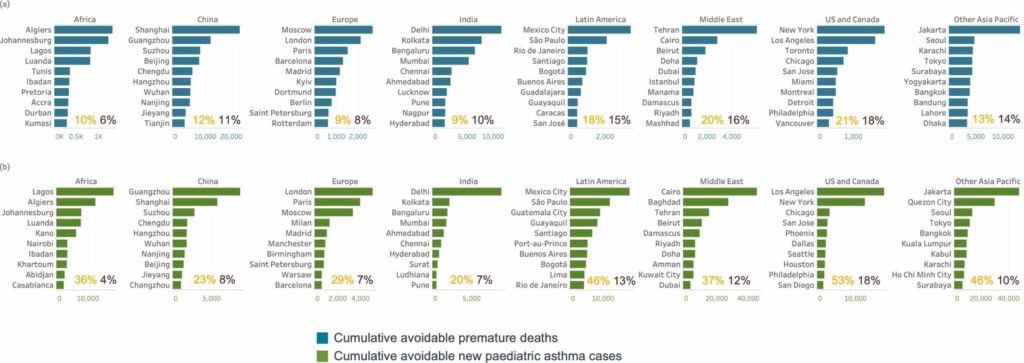
China, India and the USA are among the five hotspot countries portrayed here, in terms of avoidable deaths in top ten urban areas. Row a) is PM2.5- and ozone-attributable premature deaths and (b) NO2-attributable new paediatric asthma cases. Yellow labels show cumulative share of avoidable burden from the top ten urban areas, and brown data labels show their corresponding share of population from applicable age groups in the region.

The newly peer-reviewed study released this month aligns with the WHO’s 15-year goal to cut air pollution-linked deaths by half. On 26 May, all WHO regions endorsed this plan at the World Health Assembly in Geneva. The World Bank’s assessment is that if it’s business-as-usual, there will be a rise of 21% in the number of people who are exposed to PM 2.5 levels above [the WHO annual guideline] of five micrograms per cubic meter.

While the goal is a reduction in vehicular emissions, the report highlights the pathway for the next 15 years would be combining Euro 6 (and eventually Euro 7) and ambitious electric vehicle (EV) policies. This could avoid an additional 323,000 (39%) premature deaths and an additional 419,000 (100%) new paediatric asthma cases cumulatively worldwide from 2023 to 2040, compared to focusing on EVs alone (EV). 

But for countries that have already adopted Euro 6/VI-equivalent standards, an ambitious EV transition is vital to achieve further emissions reductions.

The new report, an updated version of a study first reported by Health Policy Watch here, identifies the most vulnerable countries by various criteria. 

Five hotspot countries 

The global hotspots for these impacts are not surprising given the density of population and vehicles. China, India, Indonesia, the United States, and Mexico together account for the largest number of avoidable deaths and new asthma cases linked to nitrogen dioxide from road transport.

Roads account for 93% of carbon emissions from Indian transport, compared with 84% in the US and 81% in China. 

“India ranks among the top five countries with the highest number of premature deaths and pediatric asthma cases from road transport emissions, with COPD and NO₂-related asthma posing major health burdens,” Amit Bhatt, ICCT India’s managing director told Health Policy Watch.
“Children under five and adults over 65 are especially vulnerable, underscoring the need for targeted policies. Though urban youth under 20 make up just 33% of the population, they account for up to 68% of avoidable NO₂-related asthma cases, highlighting the urgent need for city-level interventions. Accelerating EV adoption and ensuring a clean power grid offer India significant health and environmental gains.”

Populous middle-income countries, namely China, India, Pakistan and Indonesia, the report says, have the highest potential avoidable health impacts. These countries lead in avoidable premature deaths and ‘years of life lost.’ China, Egypt, Indonesia and India have the most avoidable new paediatric asthma cases.

Poor countries, those with lower social development indices, are likely to experience increases in new paediatric asthma cases due to growth in populations under 20 years old and changes in exposure. 

Cities are especially critical. Although urban areas house only a third of the world’s children, they account for 68% of avoidable pediatric asthma cases. 

This makes city-level action, like low-emission zones, public transport electrification, and walkable infrastructure, crucial in the fight for clean air.

HealthWatchPolicy

Air pollution Electric vehicles ICCT Pollution UNEP WHO
Share. Facebook Twitter Pinterest LinkedIn WhatsApp Reddit Tumblr Email
Abdallah el-Kurebe
  • Website
  • Facebook
  • Twitter
  • LinkedIn

Related Posts

Association urges proper metrics to boost Africa’s innovation

June 2, 2026

Nasarawa, DPI boost youth engagement on plastic waste

June 2, 2026

Airtel Africa tops NGX gains

June 2, 2026

Leave A Reply Cancel Reply

Nasarawa assembly passes health, court bills

June 3, 2026

NERC launches net billing regulations 2026

June 3, 2026

Association urges investment in Ebonyi rice sector

June 3, 2026

Alake warns against attacks on NSCDC mining marshals

June 3, 2026
About Us
About Us

ASHENEWS (AsheNewsDaily.com), published by PenPlus Online Media Publishers, is an independent online newspaper. We report development news, especially on Agriculture, Science, Health and Environment as they affect the under-reported rural and urban poor.

We also conduct investigations, especially in the areas of ASHE, as well as other general interests, including corruption, human rights, illicit financial flows, and politics.

Contact Info:
  • 1st floor, Dogon Daji House, No. 5, Maiduguri Road, Sokoto
  • +234(0)7031140009
  • ashenewsdaily@gmail.com
Facebook Twitter Instagram Pinterest
© 2026 All Rights Reserved. ASHENEWS Daily Designed & Managed By DeedsTech

Type above and press Enter to search. Press Esc to cancel.