


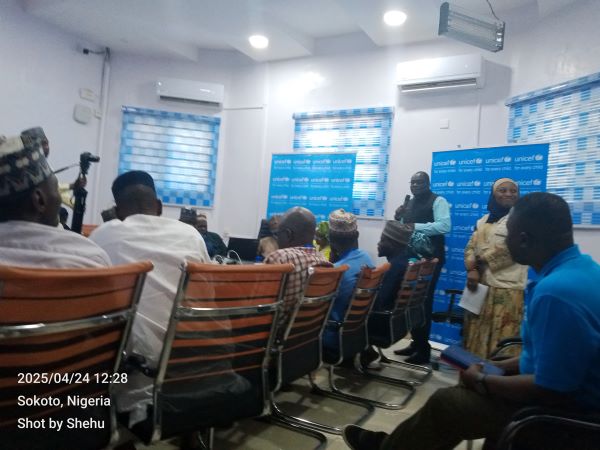
The United Nations Children’s Fund (UNICEF), Sokoto Field Office, has organized a one-day media dialogue with journalists and influencers in Sokoto State, to explore effective strategies for enlightening community members during the upcoming first round of the massive polio vaccination campaign, scheduled to commence on 25 April 2025 across all 23 local government areas of the state.
Speaking at the meeting at the UNICEF Conference Hall in Sokoto on Thursday, the Chief of the UNICEF Sokoto Field Office, Mr. Micle Jumma, emphasized that eliminating polio from Nigeria requires a collective effort from all stakeholders, including media professionals.
“The media, government, community leaders, and partners all have a role to play in this regard,” Jumma stated.
While commending community leaders for their dedication, he urged the government to intensify efforts to tackle identified challenges, particularly the issue of false finger marking—to ensure proper vaccination coverage and the eradication of polio at the state level.
In her remarks, Dr. Larai Aliyu Tambuwal, Executive Secretary of the Sokoto State Ministry of Health, said one of the key strategies to eradicate polio is the timely reporting of suspected cases.
She noted that vaccination is one of the most effective interventions for protecting children. However, she lamented that routine immunization remains poor in Sokoto State despite the efforts of various stakeholders.
She also expressed concern over the reluctance of some parents to accept the polio vaccine for their children, reiterating the government’s strong commitment to eliminating polio and other preventable diseases in the state.
Speaking during the dialogue, UNICEF Communication Specialist Ms. Pyrianca Khanna highlighted the major challenges posed by community resistance in the fight against polio in Sokoto and across Nigeria.
Khanna explained that misinformation within communities remains a significant obstacle to vaccination efforts.
“One of our main challenges is the high number of unvaccinated children in Sokoto. According to the 2023 Demographic Survey, only 11% of children have been vaccinated, which is very alarming,” she said.
She added that Nigeria is among the African countries with the highest number of polio cases and that false claims linking polio vaccines to fatalities continue to undermine immunization campaigns.
Khanna encouraged journalists to hold stakeholders accountable by following up on promises made in the fight against polio.
“Ask them: What have they done? What actions have they taken?” she urged.
She also called on caregivers and community members to ensure that children are properly vaccinated.
One of the participants, Abdallah el-Kurebe, Editor-in-Chief of ASHENEWS, noted that despite years of persuasion by the government, some parents still resist vaccination. He suggested that legal measures may now be necessary.
“The government has done a lot over the years, but with limited results. Persuasion isn’t working. We’ve seen cases where vaccines were discarded without being administered and even cases of false finger marking, sometimes in collusion with caregivers,” he said.
“Therefore, since persuasion has failed, the state government should enact a law mandating vaccination for all children.”
He cited Niger State’s approach, which advised unwilling parents to relocate, as a possible model.
Also speaking, the Chairman of the Sokoto Council of the Nigeria Union of Journalists (NUJ), Muhammad Usman Binji said journalists in the state were ready to partner with UNICEF and the State Primary Healthcare Development Agency, in creating awareness among the teeming citizens in all areas of primary health.
Delivering his address, Mr. Sabi’u Shehu, Health Promotion Officer, stated that this year’s polio immunization campaign will be conducted door-to-door to ensure that all children aged 0–59 months are vaccinated.
He called on media organizations and social media influencers to report accurately and promptly, share verified messages with the public, and properly document campaign activities to ensure the project’s success.
Shehu also urged journalists to share both the success stories and challenges of the campaign and to support transparency and accountability among stakeholders.
The media dialogue brought together journalists from various media outlets, social media influencers, UNICEF officials, and government representatives. Participants reviewed previous vaccination efforts in the state, discussed challenges, and developed strategies for a more effective 2025 polio campaign.
