


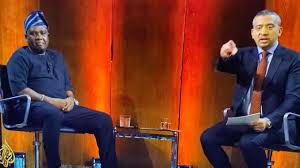
After watching the recent Head to Head interview between Mehdi Hasan and Daniel Bwala several times, I was struck by the precision and intensity of Hasan’s questioning. This was not just a political discussion; it was a masterclass in holding a guest accountable, exposing contradictions, and pressing for clarity. Hasan’s approach resembled courtroom cross-examination, where every word and past statement is carefully scrutinized.
For Nigerian journalists, there is much to learn from this interview, both in technique and in mindset.
From the very beginning, Hasan set the tone by highlighting Bwala’s political shift. Bwala, once a vocal critic of President Bola Ahmed Tinubu, has now become one of his defenders. Hasan repeatedly referenced Bwala’s previous statements, asking him to reconcile them with his current position. Watching the interview multiple times, it became clear that Hasan’s goal was to put Bwala in a tight corner: answer honestly and risk undermining either past credibility or present justification.
ALSO READ Daniel Bwala VS Mehdi Hasan: Head-to-head or headbutt? By Sadeeq Shehu
Hasan’s use of documented evidence—quotes from speeches, tweets, and prior interviews—left Bwala with almost no room for evasion. Whenever Bwala tried to deflect with general political commentary or praise for government policies, Hasan redirected the conversation back to the central issue of consistency and accountability. The repeated, focused questioning ensured that the discussion remained precise and hard-hitting.
Another key element was the moral and ethical pressure applied during the exchange. Hasan did not only ask about political positions; he also questioned whether Bwala’s past criticisms were valid or whether his current support for Tinubu reflected political opportunism. This forced the guest to justify his political reversal under the watchful eye of both the audience and the panelists.
The pace and structure of the questioning were also remarkable. Hasan fired rapid follow-up questions, leaving little room for long-winded defenses, while the panel and audience provided additional scrutiny. The result was an environment in which the guest faced constant, multi-angle interrogation—a lesson in how preparation, evidence, and live analysis can be combined effectively.
Watching the interview closely, it becomes clear that preparation is everything. Hasan’s detailed knowledge of Bwala’s past statements demonstrates the importance of thorough research before any interview. Journalists must come armed with verifiable evidence rather than relying on reactive questioning alone.
Interviews should challenge contradictions and inconsistencies rather than allow guests to give rehearsed, generalized responses. A sharper focus on follow-up questions and persistent probing can help journalists ensure accountability and prevent guests from controlling the narrative.
Equally important is the balance between firmness and professionalism. Hasan applied pressure without losing composure, showing that it is possible to be confrontational and respectful at the same time. Using evidence rather than opinion strengthens the credibility of questions, while rapid, well-timed follow-ups help maintain focus and audience engagement.
Framing questions around ethical and moral consistency also adds weight to the discussion. Challenging guests on the alignment between their words and actions ensures that interviews go beyond political rhetoric to assess integrity, credibility, and public responsibility.
Watching Hasan and Bwala multiple times, it becomes evident that modern journalism demands rigor, preparation, and courage. Mehdi Hasan’s style sets a high standard for Nigerian journalists seeking to hold public figures accountable. By combining evidence, persistence, and ethical focus, Nigerian reporters can transform interviews from mere talk shows into meaningful examinations of credibility, consistency, and integrity in public life.
To me, this interview goes beyond a simple debate; it serves as a blueprint for Nigerian journalism in the 21st century.
Binji is Sokoto state Council Chairman of the Nigeria Union of Journalists
