


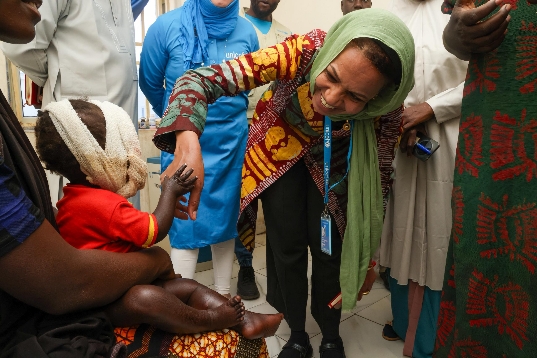
UNICEF Nigeria Country Representative, Ms. Wafaa Saeed, on Tuesday completed a full-day working visit to Zamfara State, engaging frontline health workers, government officials, caregivers and community volunteers as part of efforts to strengthen child survival, nutrition, education and protection outcomes in the state.
The visit began at the state’s Nutrition and Health Commodities Warehouse, where Ms. Saeed inspected storage facilities and interacted with health workers as well as senior officials from the Ministry of Health. She emphasised the need for stronger monitoring, supervision and evaluation to ensure nutrition commodities reach vulnerable children and mothers who need them most. She also commended Zamfara’s digital tracking system, noting that it has significantly improved accountability and last-mile delivery of essential supplies.
ALSO READ UNICEF decries Kebbi school abductions, demands accountability
At Dr. Karima Primary Health Centre, Ms. Saeed met caregivers and highlighted the importance of balanced diets using affordable, locally available foods. She reiterated UNICEF’s long-standing advocacy for exclusive breastfeeding up to two years, stressing its impact on child survival and healthy development.
The UNICEF representative also held discussions with Community Nutrition Mobilizers, including Asiya Ismail and Zuwaira Muhammad Sani, praising their critical frontline work in identifying and managing malnutrition cases at the community level. She later inaugurated suggestion boxes and help desks for each ward in the state to improve community feedback mechanisms and strengthen decision-making.
In Government House, Ms. Saeed met with the Deputy Governor, where she handed over Mama Kits designed to support safe delivery and encourage pregnant women to patronise skilled birth attendants in approved health facilities. She also launched the state’s Social and Behaviour Change (SBC) Nutrition Strategy, aimed at improving nutrition-related practices in homes and communities.
Her engagements further extended to education, where she presented 35 School-in-a-Box kits to the Wife of the Governor, to support learning for vulnerable children, reduce out-of-school numbers and promote school retention across Zamfara.
During a separate meeting with the Governor’s Wife, discussions centred on girls’ empowerment programmes, including training on reusable sanitary pad production, cotton farming for economic empowerment, strengthening integrated Qur’anic education, and promoting locally produced balanced diets from commodities readily available in the state.
The state government also made key requests. The Secretary to the State Government (SSG) appealed for UNICEF’s support in establishing model classrooms across all LGAs and developing children-friendly health facilities of international standard—one in each senatorial zone—to improve health service delivery for children. He further sought UNICEF’s assistance in system strengthening for evidence-based data sourcing to inform government policy and improve outcomes for children.
Ms. Saeed commended the Zamfara State Government for its commitment to addressing child malnutrition, particularly its provision of counterpart nutrition funding and procurement of Ready-to-Use Therapeutic Food (RUTF).
Her visit, she noted, reaffirms UNICEF’s continued partnership with Zamfara State to ensure every child survives, thrives and reaches their full potential.
