



The world’s leading polio eradication programme faces a 40% budget cut next year as the paralysis-causing virus surges in its last strongholds of Afghanistan and Pakistan and war-torn regions, threatening to reverse decades of progress toward eradicating the disease.
By Disha Shetty & Stefan Anderson
“The Global Polio Eradication Initiative is facing a 40% budget cut in 2026,” Dr Hanan Balkhy, regional director of the WHO’s Eastern Mediterranean Regional Office, told the World Health Assembly on Friday — the same body that launched the global eradication effort 36 years ago.
The convergence of funding cuts, conflict, and viral resurgence now threatens to unravel humanity’s near-victory over a virus that would become only the second human disease ever eradicated after smallpox.
Polio paralysed or killed over half a million people worldwide every year at its peak in the 1940s and 1950s, attacking the nervous system and causing irreversible paralysis within hours, primarily affecting children under five.
Since the Global Polio Eradication Initiative launched in 1988 — co-led by WHO with Rotary International, the US CDC, UNICEF, the Gates Foundation, and Gavi, The Vaccine Alliance — cases have dropped by 99% worldwide.
“We are at a tipping point. Either we invest now to finish the job or risk a global resurgence,” Balkhy told the assembly. “We do not have the luxury of time.”
Funding crisis deepens
GPEI’s funding problems were out in the open before the current budget crisis. Last October, the initiative admitted it needed more time and money to reach its eradication targets, pushing the deadline to 2027 for wild poliovirus and 2029 for vaccine-derived strains.
The original eradication target was 2000.
The initiative raised its budget request to $6.9 billion through 2029, up from an original $4.8 billion. So far, GPEI has received or secured pledges for $4.6 billion, nearly matching its original target. But with the increased costs, the WHO-led initiative now faces a funding gap of $2.3 billion through 2029.
The budget shortfall stems significantly from the withdrawal of the United States from the WHO, with both USAID and the US Centres for Disease Control (CDC) disengaging from GPEI.
“As 2024 began, we were on the verge of eradicating wild poliovirus in Afghanistan and Pakistan, the last two polio-endemic countries,” Balkhy told the WHO’s executive board in February. “But then came a resurgence, alongside outbreaks of variant poliovirus in Somalia, Sudan, Yemen and the Gaza Strip.”
WHO’s Emergency Committee unanimously agreed last month that “the risk of international spread of poliovirus continues to constitute a Public Health Emergency of International Concern,” the UN health body’s highest level of alarm.
The wealthy elephant
The elephant in the room at the World Health Assembly was the US departure from global health efforts — no delegate directly mentioned it by name during the polio discussions, marking the first time the United States has not attended the meeting.
But Balkhy was more direct at WHO’s February executive board meeting.
“The disengagement of CDC and USAID is costing us already with the loss of their technical, strategic and functional support,” she told the board.
“In financial terms, this means a loss of $133 million to the GPEI, and a loss of $100 million for WHO’s polio-specific operations each year,” Balkhy explained, bringing the total annual shortfall in eradication efforts to $233 million.
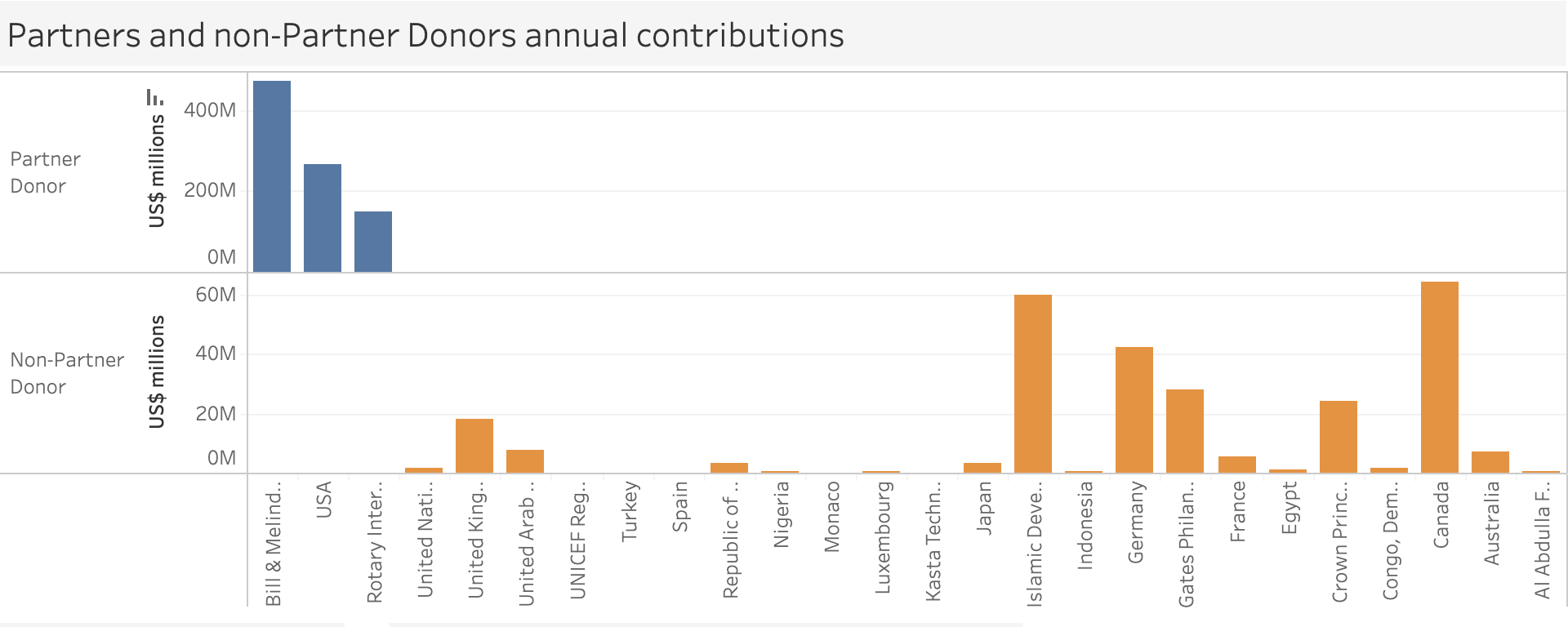
The US has been GPEI’s second-largest historical donor at 22.6% of total funding since 1988, contributing $4.5 billion over the programme’s lifetime, second only to the Bill and Melinda Gates Foundation at 40%.
The US contributed $265 million of the $907 million received by GPEI in 2023, nearly 30% of annual funding. A USAID factsheet published in January noted the agency had supported 2,396 health facilities employing over 10,000 female health workers in Afghanistan the past year alone.

The gap between the US and other government donors is vast: Canada, the next largest single-country donor, has contributed just 5.5% of the total funding, while Germany has given 3.6%. Canada, now the second-biggest state donor after the US withdrawal, contributes $62 million annually, less than a quarter of what the US provided.
Some nations have pledged to step up support in the wake of the US departure. Saudi Arabia, which had not donated to the programme in nearly a decade, pledged $500 million to GPEI in February. Canada committed an additional $151 million over the next three years late last year. Yet the funding gap remains large.
The US was also a major player in the polio fight outside GPEI itself. GPEI fundraising documents show the US CDC’s polio efforts totalled $354 million in 2021 and 2022, while USAID contributed $140 million over the same period.
The sweeping US cuts to its humanitarian programmes also include a $131 million grant to UNICEF’s polio immunisation programme, which paid for planning, logistics and delivery of vaccines to millions of children.
“We remind member states that investing in polio eradication has saved more than 20 million people from paralysis, helped provide a range of vital health services for children and is an investment in global health security,” a UN Foundation delegate said.
Cases surge in polio final mountain strongholds
Wild poliovirus spreads through contaminated water or food and can cause irreversible paralysis within hours, while vaccine-derived strains emerge when the weakened virus in oral vaccines mutates in areas with poor sanitation.
Afghanistan and Pakistan, the last two countries where wild poliovirus remains endemic, saw cases rise dramatically in 2024. Afghanistan recorded 23 cases last year, up 283% from 2023, while Pakistan saw 63 cases, a 550% increase.
Endemic transmission remains concentrated in high-risk districts along the Hindu Kush mountain range that forms the rugged border between Pakistan’s southern Khyber Pakhtunkhwa province and Afghanistan’s eastern region, where cross-border movement, militant activity and attacks on vaccination teams complicate immunisation efforts.
WHO figures show 99 wild poliovirus type 1 cases were reported in 2024, with three additional cases recorded in 2025 as of 10 April. Environmental surveillance — testing sewage and water sources for the virus — detected 741 positive samples in 2024 (113 in Afghanistan, 628 in Pakistan), with 80 more reported in the first weeks of 2025.
India, which shares a border with Pakistan, stressed the need for regional collaboration at the assembly. “Regionally, it is crucial to foster collaboration and share data, synchronise vaccination campaigns and work together to prevent the re-emergence of disease across borders,” India’s delegate said.
Vaccine hurdles
The virus persists despite massive vaccination efforts and international support. Achieving the 95% coverage needed for herd immunity remains elusive in endemic regions where every child needs multiple doses. Vast distances, insecurity, and deep-rooted distrust complicate an already difficult task.
Over 534,000 children are vaccinated monthly in Afghanistan alone, with 11.4 million vaccinated last year, according to the WHO. Yet Afghanistan’s Islamic Emirate paused the polio immunisation programme twice in 2024 and now restricts vaccine delivery to mosques and village centres only, ending door-to-door campaigns that are crucial for reaching every child.
In Pakistan, only 84% of eligible children received two doses of the injectable vaccine in 2023. More than half of the polio cases in Pakistan last year were in children who hadn’t received a single dose.
Vaccine hesitancy remains entrenched in parts of both countries, with some believing vaccines affect fertility or are part of a Western conspiracy — distrust earned after the CIA operated a fake vaccination campaign while searching for Osama bin Laden in 2011.
The funding cuts compound these challenges on the ground.
“Cuts in development assistance are threatening both eradication efforts and essential services at this point,” said Dr Jamal Ahmed, Director of WHO’s Polio Eradication Programme and Chair of the GPEI’s Strategy Committee. “The challenge we have faced last year and a few years ago, and was highlighted by our member state today, is the global supply of vaccine and vaccine security.”
Vaccine-derived variants spread
Beyond the wild virus, vaccine-derived poliovirus variants have emerged in 35 countries across Africa, Asia and the Middle East, as well as Spain in 2024.
These strains can develop when the weakened virus used in oral polio vaccines mutates in areas with poor sanitation and low vaccination coverage, regaining the ability to cause paralysis. Wealthier nations have shifted to inactivated polio vaccines, which are only effective at extremely high uptake rates and when polio is nearly eradicated.
Vaccine-derived variants were detected in Cameroon, Djibouti, Gaza, French Guiana, Ghana, Spain and Zimbabwe, WHO data shows. The United States reported 31 cases in 2022 — its first in a decade.
GAVI, the vaccine alliance, expressed concern about polio’s re-emergence in previously cleared areas.
“To achieve and maintain a world free of poliovirus, we must prioritise scaling up routine immunisation and reaching the under- and unvaccinated children worldwide,” GAVI’s representative told the assembly.
Conflicts drive resurgence
War and humanitarian crises create ideal conditions for polio’s spread as health systems collapse, vaccination campaigns halt, and populations flee their homes. Overcrowded displacement camps with poor sanitation allow the virus to circulate rapidly among unvaccinated children.
In Yemen, which had been polio-free since 2009, an outbreak of circulating vaccine-derived poliovirus emerged in 2020 amid civil war that has killed over 150,000 people, UN estimates show, with additional estimates of more than 227,000 dead from famine and lack of healthcare facilities due to the war.
“Cases of polio have reduced in the south of Yemen. Unfortunately, we still see cases recorded in the north of the country, in regions which are outside of the control of the legitimate authorities,” a Yemeni delegate told the assembly.
Gaza has faced similar challenges. While a February ceasefire allowed WHO to vaccinate 46,000 children, the campaign has since stalled. “Intensified attacks, a blockade of aid, and communities deprived of water, food and medicines… [we] have suspended the fourth vaccination round,” Balkhy said.
Sudan’s civil war, which has displaced millions and destroyed health infrastructure, has also seen vaccine-derived polio cases emerge as routine immunisation collapses.
“Because of the war and the financial constraints we are having … we are calling upon countries to show solidarity,” Sudan’s delegate said. “Help us in order to ensure surveillance and the protection of frontline officers and workers.”
As war zones open new frontlines in the polio fight, whether the international community can mobilise the $2.3 billion needed to finish the job will determine the fate of global eradication efforts that have spanned nearly four decades.
