


Twelve-year-old Obiademoh (not his real name) was bursting with life. He loved playing football with his friends, tinkering with gadgets, and dreaming of one day becoming an engineer.
But on February 22, 2025, he presented with a sore throat and fever at the health facility of his school, King’s College, Victoria Island Annex, Lagos.
Laboratory tests confirmed that he had diphtheria, after which he was referred and admitted to the paediatric emergency ward of the Lagos University Teaching Hospital (LUTH), where he was administered antibiotics and diphtheria antitoxin serum.
Despite the intervention, Obiademoh died from myocarditis—an inflammation of the heart muscle that weakens the heart’s ability to pump blood—while several other students were hospitalised as suspected cases.
Obiademoh’s parents were devastated, left with an unfilled void. “Their little boy, their bundle of joy, is gone.”
Consequently, parents whose children were referred to the teaching hospital were notified through phone calls and rushed to keep vigil at the emergency ward.
The diphtheria outbreak later reported in multiple local government areas (LGAs) of Lagos recorded 10 laboratory-confirmed cases.
The Lagos State Commissioner for Health, Prof. Akin Abayomi, disclosed that the confirmed cases were linked to King’s College in Eti-Osa LGA, Lagos State Model School, Meran in Alimosho LGA, Lagos University Teaching Hospital (LUTH) in Mushin, De-Emmaculate School, Mile 12 in Kosofe LGA, and Gbara Junior Secondary School in Eti-Osa LGA.
Similarly, a diphtheria outbreak in Mbutu Community in Imo State led to the death of 10 children, prompting the immediate closure of schools in the area.
In addition, in May 2025, the disease killed two children in Tukur-Tukur Community of Zaria, Kaduna State.
A community leader and Director of Publicity of the Northern Elders Forum, Abdul-Azeez Suleiman, disclosed that the two children died within 48 hours.
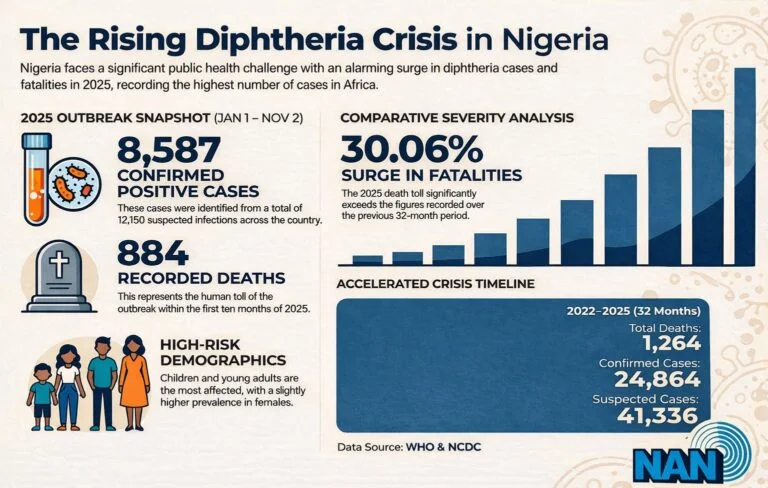
Sadly, Obiademoh and these children were not the only victims, as Nigeria lost 884 people to diphtheria between January 1 and November 2, 2025.
Regrettably, Nigeria accounted for the highest number of diphtheria cases in Africa in 2025, with 12,150 suspected cases, of which 8,587 were confirmed positive.
According to the World Health Organisation, children and young adults represented the majority of the cases, with females accounting for a slightly higher proportion.
In contrast, Nigeria recorded 41,336 suspected cases, 24,864 confirmed cases and 1,264 deaths between epidemiological week 19 of 2022 and week four of 2025.
Epidemiological week 19 of 2022 marked the start of a severe diphtheria outbreak in Nigeria, which has been recognised as the worst outbreak in a decade.
Analysis of the figures shows that the fatality recorded in 2025 was 30.06 per cent higher than the figure recorded over the 32 months and two weeks between epidemiological week 19 of 2022 and week four of 2025.
In consequence, this alarming trend demands immediate attention and action.
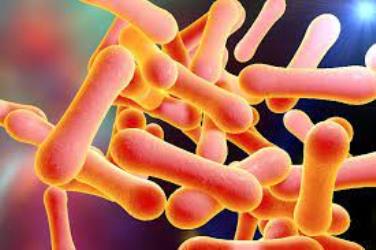
Diphtheria is a vaccine-preventable but severe bacterial infection that can affect a person’s nose, throat and, occasionally, the skin. It is caused by Corynebacterium species.
Those at greatest risk of contracting diphtheria are children and people who have not received any, or only a single dose of, the vaccine (diphtheria toxoid–containing vaccine).
As such, the rising positivity and fatality rates from diphtheria call for proactive measures, a public health physician, Prof. Tanimola Akande, said.
Akande, a Professor of Public Health at the University of Ilorin, emphasised that diphtheria has continued to pose a significant public health risk in Nigeria, with the country having one of the highest numbers of unvaccinated children globally.
This, he said, had led to recurring outbreaks and deaths from vaccine-preventable diseases (VPDs), stressing that the situation demanded urgent efforts to boost vaccination coverage and prevent further losses.
He advised parents to ensure their children were fully vaccinated against diphtheria with three doses of the pentavalent vaccine, as recommended in the childhood immunisation schedule.
Similarly, a child health advocate, Mrs Helen Orji, said: “In a world where medical breakthroughs happen every day, it’s heartbreaking to think that thousands of Nigerian children are still dying from vaccine-preventable diseases when the solution—the vaccine—is readily available.
“Who is failing these children? Is it the parents who refuse to authorise the inoculation of their children because of fear, ignorance, misinformation or religious beliefs?
“Or the government that has failed to enforce compliance in schools that disregard safety protocols for monetary gains, admitting more students than their capacity, leading to overcrowding and overstretched facilities?
“Schools are fountains of knowledge and nurture dreams. Enough of schools being slaughter slabs for promising children.”
She urged the government to rise to its responsibilities by intensifying awareness campaigns, improving hygiene practices and expanding vaccination coverage.
In Nigeria, no fewer than two million children are under-immunised, including zero-dose children—the highest number globally—highlighting the high risk of disease transmission.
Preventing the recurrence of diphtheria outbreaks in Africa’s most populous nation would require strengthened health systems, particularly through robust routine immunisation coverage and sustained public sensitisation, a general physician, Dr Jonathan Esegine, asserted.
However, a businesswoman, Mrs Victoria Araoye, faulted the government’s approach to public health communication, saying: “They are not being transparent.
“Public health issues should not be shrouded in secrecy, as is often the case in most Nigerian states, especially Lagos.
“Often, the public only hears about an outbreak when the media breaks the news or through viral social media posts. After that, you see government officials rushing to explain.
“It doesn’t have to be this way because an informed society is an empowered one.”
She added that timely risk communication played a critical role in informing and educating the public and in preventing panic, which often drives mistrust, misinformation and risky behaviour.
However, the Permanent Secretary of the Lagos State Primary Health Care Board, Dr Ibrahim Mustafa, disclosed the state’s efforts to intensify routine immunisation against vaccine-preventable diseases, especially diphtheria, to achieve herd immunity in communities.
“As we have seen in recent outbreaks, preparedness allows for rapid response when an emergency strikes,” he said.
In addition, he identified the adoption of a multi-sectoral and multi-stakeholder partnership approach as key to preventing a recurrence of outbreaks in the state.
He listed stakeholders to include the Ministry of Education; Ministry of Local Government and Chieftaincy Affairs; Office of Education Quality Assurance; State Universal Basic Education Board (SUBEB); religious and traditional rulers; and community development associations.
Mustafa, however, maintained that the government’s priority during an outbreak is to control the spread, and that sharing information with the public helps people take necessary precautions to protect themselves.
Experts suggested that strengthening vaccination efforts, especially in areas with low immunisation coverage, enhancing surveillance and response systems, and fostering community engagement were essential steps to prevent the recurrence of outbreaks.
They emphasised that timely case detection, coordinated response and effective clinical management remained critical to limiting transmission and reducing the high fatality rates observed in recent diphtheria outbreaks.
In addition, they submitted that addressing vaccine hesitancy and improving access to healthcare services were vital.
By taking these steps in 2026, the experts said, Nigeria could mitigate the transmission of diphtheria and protect its most vulnerable populations.
NANFeatures
