


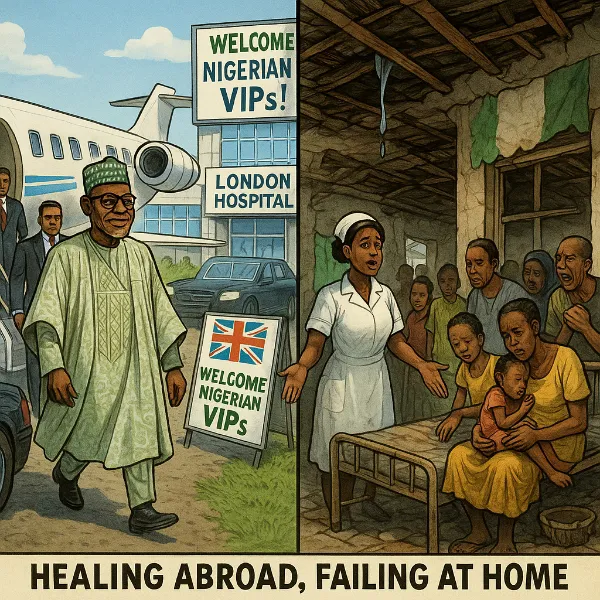
Health sector stakeholders have warned that Nigeria’s estimated $1.3 billion annual spending on medical tourism reflects a deeper crisis of public confidence in the country’s healthcare system, beyond funding gaps or infrastructure deficits.
Speaking with reporters on Friday in Abuja, experts said the continued flight of patients and health professionals points to an erosion of trust, with long-term implications for service delivery and workforce morale.
Dr. Richard Ajayi, Executive Vice Chairman of Bridge Clinic Fertility Centre, said many Nigerians no longer trust the health system to protect, diagnose, or treat serious medical conditions. He added that the trend is worsened when government officials themselves seek treatment abroad, reinforcing public perceptions that local hospitals, regulatory frameworks, and oversight structures are unreliable.
“The core crisis goes beyond worker migration or underfunding,” Ajayi said. “It centers on the gradual erosion of belief in hospitals, health professionals, institutions, and leadership stewardship across the national system.” He noted that trust grows when leadership demonstrates accountability, regulation functions effectively, financing is transparent, and health workers are respected as partners in policy and service delivery.
Recent data from the Central Bank of Nigeria (CBN) indicates a sharp decline in outward medical spending, highlighting changing patterns in overseas healthcare utilization. Between January and June 2025, spending on medical tourism fell by 96.2 percent compared with the same period in 2024. Total spending dropped from $2.38 million in the first half of 2024 to just $0.09 million in 2025, reflecting reduced foreign exchange availability, delayed travel decisions, and heightened economic uncertainty.
Analysts, however, caution that declining expenditure does not necessarily indicate restored confidence in domestic healthcare. Dr. Muyiwa Tegbe, Managing Partner at Park Harmon Advisory, said suppressed demand may mask persistent trust deficits. He noted that many Nigerians still avoid formal care, opting instead for home births, self-medication, or informal treatments, which increases health risks and delays access to life-saving care.
Dr. Benjamin Obire, Founder of Health-Hub Africa, emphasized that the $1.3 billion annual medical tourism bill is a crisis of trust, not merely economics. He noted that the funds could finance about 50 tertiary hospitals, each with 120 beds, significantly expanding access and capacity across the country. Obire also highlighted the human cost: more than half of Nigeria’s registered doctors now practice abroad, resulting in billions of dollars lost in training investments since 2010.
He called for health sector development to focus on rebuilding citizen and workforce trust, rather than solely curbing capital flight. “Trust can be restored when professionals are respected, leaders are accountable, policies are implemented, and hospitals consistently deliver care with dignity, supported by proper funding, oversight, and ethical governance,” Obire said.
