


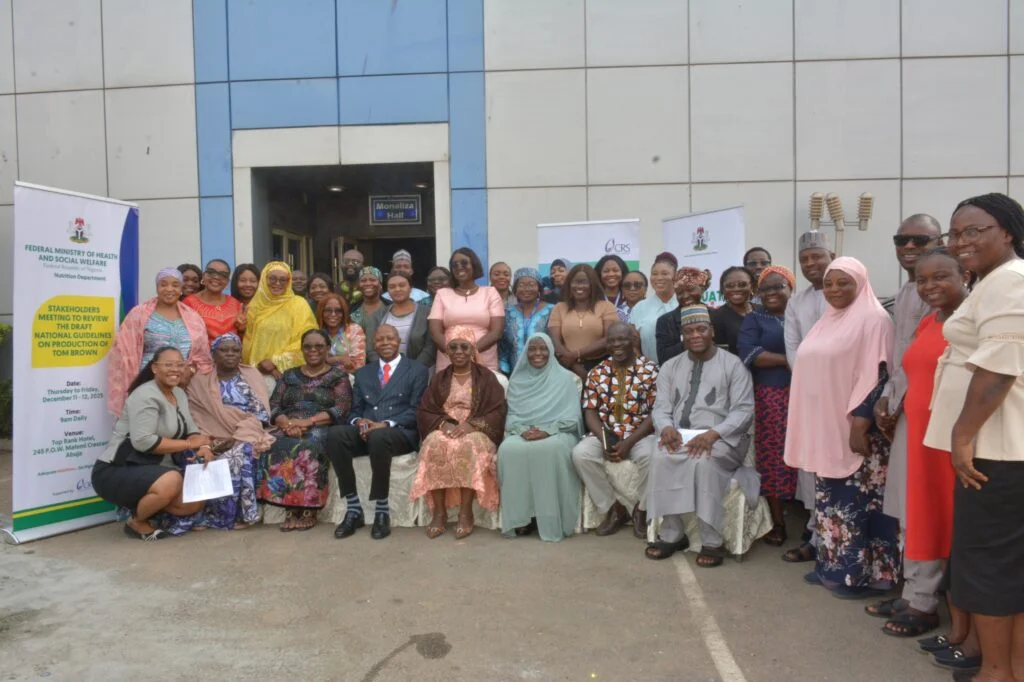
The Federal Ministry of Health and Social Welfare says standardizing the production of Tom Brown will help tackle Nigeria’s high malnutrition rates and improve child nutrition across communities.
Mrs. Ladidi Bako-Aiyegbusi, Director of the Nutrition Department, stated this on Thursday in Abuja at a two-day stakeholders’ meeting to review the Draft National Guidelines on Tom Brown Production, organized with support from Catholic Relief Services (CRS).
She said unified standards were urgently needed because current production practices varied widely in composition and safety.
“There is a dire need to develop National Guidelines on Tom Brown Production and Implementation to ensure quality, consistency, safety, and scalability nationwide,” Bako-Aiyegbusi said.
She added that representatives from state Ministries of Health, Agriculture, Education, Water Resources, Women Affairs and Information were involved to ensure the guidelines reflect local realities.
“The discussion is being done in collaboration with the states. Tom Brown wouldn’t just be a household item. Eventually, communities could produce it on a large scale and generate income,” she said, noting that Borno and Kano States had already begun exploring large-scale production opportunities.
Bako-Aiyegbusi explained that Tom Brown, enriched with ingredients such as crayfish and soybeans, was central to improving complementary feeding in low-income households.
“From six months, nutrients from breast milk alone are insufficient. We encourage parents to enrich family foods rather than buying expensive packaged meals,” she said.
On malnutrition, she highlighted Nigeria’s “triple burden,” citing the 2024 Nigeria Demographic and Health Survey: stunting at 40 per cent, wasting at 8 per cent, and underweight at 27 per cent, with breastfeeding rates stagnant at 29 per cent.
She noted that three companies were now certified to produce ready-to-use therapeutic foods for children with severe malnutrition.
CRS Nigeria Country Representative, Mr. Akim Kikonda, said the meeting marked a key step toward improving child nutrition and reducing reliance on costly imported supplements.
He noted that Tom Brown costs between N72,000 and N96,000 per child for an eight-week treatment cycle, compared with imported alternatives that cost up to N360,000 for the same period.
CRS Emergency Coordinator, Mr. Wilson Kipchoech, said Tom Brown had proven cost-effective in managing malnutrition and had been implemented in Northeast Nigeria since 2015, with recent expansion to Sokoto.
“It is easily scalable, and we have seen results. Partnering with government to expand and institutionalize it is highly welcomed,” he said.
Kipchoech expressed optimism that the meeting would lead to a unified policy framework.
“Different agencies have been producing it slightly differently, but now the government will provide a standardized approach,” he said.
It was reported that Tom Brown is made from roasted cereals and legumes such as maize, millet, soybeans and groundnuts, and is widely accepted for its affordability and nutritional value.
