


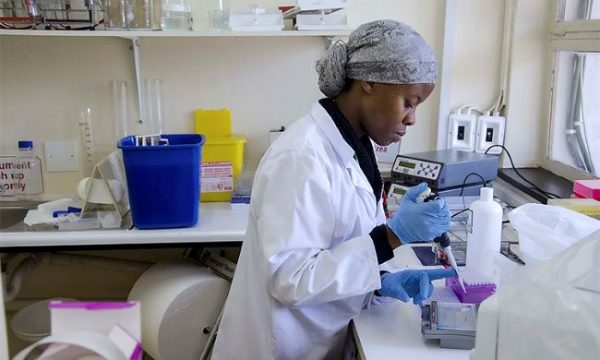
The Federal Government has reaffirmed its commitment to building a knowledge-based economy anchored on Science, Technology and Innovation (STI), as efforts intensify to close the long-standing gap between academic research and industry.
The Minister of Innovation, Science and Technology, Dr. Kingsley Udeh, made this known at the opening of the 7th Annual Scientific Conference of the Nigerian Academy of Science (NAS) in Abuja on Wednesday. The two-day conference is themed “From Research to Market: The Making of Knowledge-Based Economies.”
Represented by Dr. Olugbenga Fadigbe, Udeh said Nigeria must move beyond knowledge generation to deliberate and structured commercialization of research outputs, noting that innovation-driven economies thrive on the translation of ideas into market-ready solutions.
According to him, the commercialization of research products remains a core pillar of his vision since assuming office.
“At the ministry, we are committed to strengthening Nigeria’s innovation ecosystem by promoting demand-driven research, supporting technology incubation and transfer, encouraging public-private partnerships, and fostering homegrown solutions that address national priorities in agriculture, energy, health, infrastructure and industrial development,” the minister said.
He stressed that sustainable development could only be achieved when scientific research is clearly linked to commercialization pathways that deliver measurable economic and social value.
Also speaking, the Minister of Budget and Economic Planning, Senator Abubakar Bagudu, said no nation could attain sustainable development without deliberately connecting research outcomes to productive enterprise.
Represented by the Director of Economic Growth, Mr. Auwal Mohammed, Bagudu noted that a knowledge-based economy flourishes where ideas are nurtured, innovations are commercialized, and research findings are effectively communicated to policymakers, entrepreneurs and industry players.
He added that the Federal Government recognizes the critical role of STI in national development and remains committed to deepening partnerships with institutions such as the Nigerian Academy of Science.
In her keynote address, Founder of The Chair Centre Group, Mrs. Ibukun Awosika, lamented the disconnect between science-based university departments and market realities, describing the gap as a major obstacle to national development.
Awosika argued that research conducted by science-driven industries should be deliberately linked to relevant university departments.
“If we do not intentionally build structures that connect universities to the market, valuable research findings will remain on the shelves as academic papers instead of solutions to real problems,” she said.
She noted that Nigeria possesses innovative minds, strong interest and numerous societal challenges that could be converted into economic assets if science is properly harnessed to solve real-life problems.
Awosika further urged scientists to take responsibility for identifying societal problems, engaging industries interested in addressing them, and collaborating to deliver practical solutions, adding that the right strategy is critical to achieving set goals.
Earlier, the President of the Nigerian Academy of Science, Prof. Abubakar Sambo, said for Nigeria to achieve meaningful growth and development, research must transcend laboratories and academic institutions and impact everyday life.
He observed that despite the country’s rich human capital, vast natural resources and youthful population, inadequate integration of research outcomes into the economy has continued to limit development.
“As scientists, policymakers and stakeholders, we must work together to create an environment where research outputs align with industrial needs, innovations find clear pathways to the market, and knowledge generates wealth and employment,” Sambo said.
He added that the academy’s goal is to position Nigeria as a hub for scientific excellence and technological advancement in Africa.
