


Ajijah Andrew, 43, is a regular blood donor whose first donation was in 1998 while in the Command Day Secondary School Jos. It was then just a casual action till in 2015 when his perspective on the exercise changed.
By Martha Agas
As a journalist, the aftermath of covering the 2015 Jos crisis resulted in bouts of headaches for him which had forced him to seek for medical check. The doctor encouraged him to donate blood as a potential solution to address his condition.
A medical expert, Dr Juliette Katung explains that blood donation, in addition to improving physical health, also boosts the psychological and emotional wellbeing of donors by reducing their stress.
He indeed felt better after the procedure and the incident became the turning point of his regular blood donation to those who personally request for such assistance at the National Blood Service Commission (NBSC), North-Central office in Jos.
“
Since I became aware of the health benefits of blood donation, I ensure to comply with the minimum blood donation requirement of every three months, and I am fulfilled not only by feeling healthy but also with giving people a chance to be alive,” he says.
Bot Dung, 60, a medical laboratory technician is the highest blood donor in Plateau. He has donated blood 100 times to the NBSC in Jos, and even after recovering from a major surgery in 2011, which left him with one kidney, it hasn’t deterred him from still sustaining regular blood donation as a lifestyle.
ALSO READ: NBSC seeks improved partnerships, awareness for voluntary blood donation
He says he had experienced persistent headaches and high blood pressure, both of which his regular blood donation has helped to address.
I started donating blood in 2008 with a break in 2011 and 2012 due to my surgery. I haven`t taken any hypertension medication for three years now, anytime I donate I feel strong, I feel lighter,” he said.
Bot donates blood bimonthly and has been an ardent advocate of blood donation in the state, particularly at the College of Health Technology Zawan, where he worked till he retired in 2023. It is one of the leading schools in Plateau in voluntary unpaid blood donation.
Similarly, an entrepreneur Grace Izam, 50, the highest female blood donor in Plateau, claims she has donated blood 82 times. She started donation in 2017 when the NBSC team came to her church at Hwolshe for their blood drive clinic.
Like other donors, Izam says regular blood donation has helped her to monitor her health status through its screening processes and has further guided her to lead a conscientious healthy lifestyle so as to continuously contribute to saving lives.
Ajijah, Bot and Izam are part of the statistics of the 72,015 unpaid voluntary blood donors in the NBSC`s North Zonal Centre Jos, from 2017 to 2022. According to data from the service, it has consistently been the highest in the country among its seven centres within the period
Blood donation is crucial in saving lives of a country. The World Health Organisation estimates that 30 per cent of children who die daily in Nigeria, is due to causes related to anaemia, while post-partum haemorrhage is the lead cause of maternal mortality, and bleeding from road traffic accidents, the lead cause of death amongst the young and middle aged.
About 500,000 units of blood are being collected annually with 25,000 from unpaid volunteer donors, which is 25 per cent of the expected blood donation. This is below Nigeria`s estimated blood needs of about 1.8 million pints per annum with its high population of more than 225 million .
Plateau, the north central region`s host still remains a model to other states in Nigeria with its consistent ranking of the highest blood collection from unpaid voluntary donors and is leading in the country in addressing the blood needs of its region.
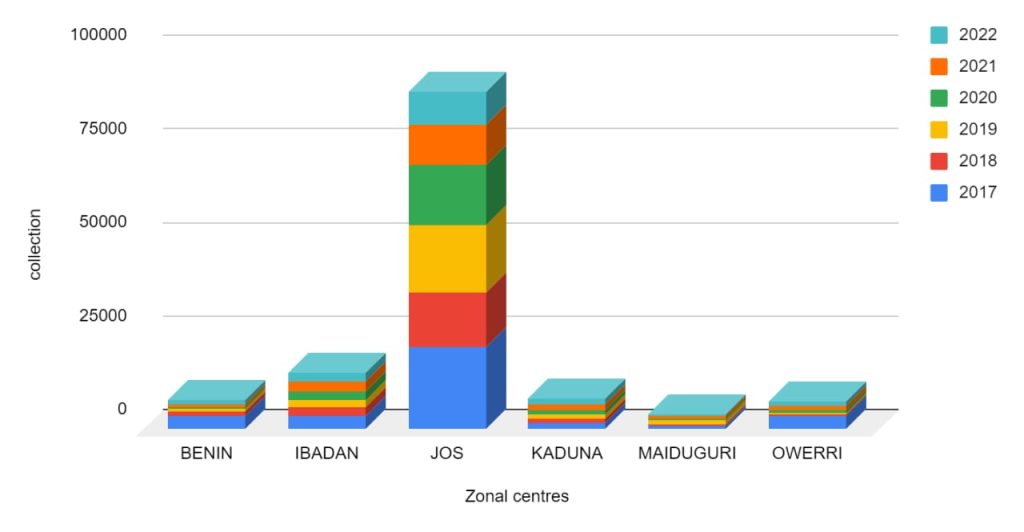
NBSC blood collection trend from 2017-2022 Graph: NAN data: NBSC
Why is Plateau leading in blood donation
Stakeholders such as the Nigerian Medical Association (NMA) have applauded the Jos centre for its noteworthy strides in blood collection. Its chairman in Plateau, Dr Bapigaan Audu, attributes the regions` s success to the increased awareness and concern of its residents, who recognise the importance of assisting the needy in that regard.
Experts say that Plateau have witnessed high demand for blood to meet transfusion needs driven by the perennial unrests in the state, vehicular road accidents, demand resulting from diseases such as malaria, obstetrics and gynaecological bleeding and cancers amongst others.
The north central zone comprising of Benue, Kogi, Nasarawa, Niger, Kwara and FCT has adopted several strategies to have high figures compared to other zones of the federation.
Stakeholders say the staff in the zonal office are noted for being highly-motivated, a strength which the Zonal Coordinator of the service, Prof Damulak Dapus, says is demonstrated in the passion for their duties. This aligns with one of the thematic areas outlined in the organisation`s 10 -year strategic plan
He says since inception of their services in Jos on April 27, 2007, the team built a strong foundation and were intentional in saving lives as reflected in their good performance of topping all zones over the years.
The coordinator says “In the country, we overtook in terms of mobilisation and motivation of staff, sensitisation for public awareness creation, getting volunteer recruitment into blood donation.
“And within a short while, we have completely eliminated family replacement and paid donation and relied heavily and solely on volunteer donors. And this is very important because we made the donors to know that it is not just an attempt at saving somebody’s life.But also primarily of improving their own personal life by donating blood regularly.
Strategies adopted
Public campaigns
The North Central zone embarked on public campaigns to encourage voluntary unpaid blood donation. According to their Monitoring and Evaluation (M&E)Officer, Mrs Faith Gaya, the centre had conducted 373 outreaches from October 28, 2018 to November 26, 2023 to worship centres, high institutions, organisations, markets and communities in the state.
The head of the office says “We visit heads of organisations, heads of educational institutions, head of religious and even denominational heads and residential heads of churches where we discuss with them the benefits of the act.
“During such outreaches, prospective donors were enlightened on the importance of blood donation especially as the region over the years has been experiencing violent conflicts and other security challenges, where many got injured and required blood to survive particularly in emergency periods.
Damulak explained that in addition to saving lives, donors improve theirs through rejuvenation of blood cells who survive between 120 to 150 days, a knowledge which has made them willing to continue donating blood
The frequent donation he says, will create room for the production of younger blood cells, which are more vibrant, more metabolically active, more efficient and also possess accurate oxygen and delivery.
“It(donation) makes us more resistant to aging, more resistant to bleeding, more resistant to infections and therefore it empowers the donor to be healthier than he was before donating blood,” he said.
Donor Retention
A study revealed that the Jos center has an increasing rate of blood donor recruitment and high retention of safe ones for regular donation.
Findings reveal that donors` retention has been the strength of the centre. It has been able to retain 80 per cent of them consistently for five years and more.
The head of the centre says it has donors who have given blood up to 50 to 60 times and is also leading by example in the exercise with his staff.
“I personally want to also lead by example, which I believe it is also motivating to other people. I have donated 81 times.
So even without us going for blood drive, if we just carry the register of our attendance and we keep reminding them, we will have 50 per cent of the blood via this channel. And of course, that is not even enough because we are supposed to cover the North Central Nigeria.
“Donors have been instrumental and advocates of the centre’s awareness and sensitisation campaigns and agents of recruitment of new donors. So that has led us to what we call donor`s donor recruitment.”
The M&E officer said that they maintain a strong clientele relationship with their donors through periodic communication especially in checking on their well-being after donation and felicitating with them on their anniversaries.
The relationship has also led to the establishment of blood donation support groups on social media, where requests are made on voluntary unpaid donation for patients.
Improving blood donation
While the Jos centre has been leading in the country, stakeholders say that there is still room for improvement in the discharge of their services as the number of donors also declined in some years.
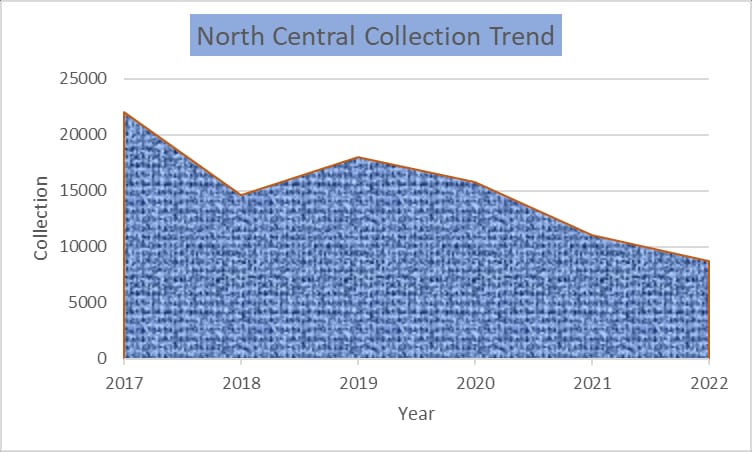
Jos centre collection trend Graph: NAN Data: NBSC
The coordinator explained that the decline was due to inadequate provisions of medical reagents and consumables such as blood bags.
He called for the upward review of budgetary allocation to address the situation and improved infrastructure particularly in blood collection and distribution.
He said that technologies such as the use of drones could be employed for blood distribution, similar to how it is done in Rwanda.
Apheresis procedure, he said should be adopted in NBSC centres using centrifuge machine. The procedure involves utilising a medical technology for the collection of various blood components from the same donor during a single session and returning the remaining blood to the donor through transfusion, only the Abuja centre currently has this machine.
Apheresis involves the removal of blood from a vein to treat a blood disorder and it is usually done to remove whole blood and red blood cells, and/or iron stores.
He also called for quality assurance measures to ensure that blood donated in Nigeria meets the standard set by international accrediting bodies.
The highest blood donors at the Jos centre, Bot and Izam, called for regular advocacy and engagement with rural people for their outreaches.
Izam recommended the conduct of regular interface meetings with existing donors and potential ones in different communities instead of solely relying on the celebration of world donor day for their advocacy.
In addition, she also urged for increased focus on dispelling myths on blood donation while simultaneously strengthening clientele relationship.
For Bot, though a voluntary exercise, stipend should be provided to donors to encourage them in the exercise as some travel long distance to donate blood.
While Nigeria is still far from meeting the blood needs of its people, stakeholders are hopeful that improved funding, technology and enlightenment would help NBSC achieve its plans to increase the number of blood units collected from voluntary non renumerated donors to three million by 2030.
