


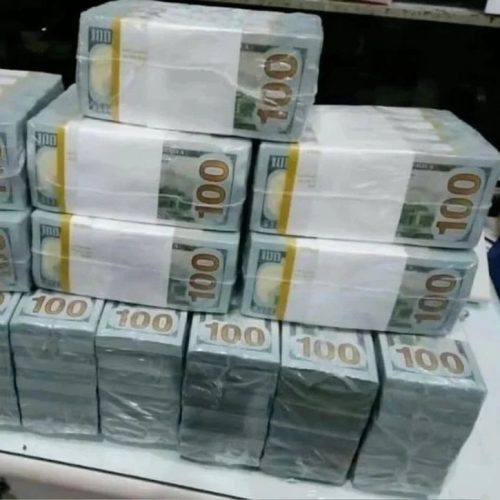
The US dollar climbed to a one-week high against major currencies on Monday, as renewed tensions between the United States and Iran dampened prospects for a Middle East peace deal and pushed investors toward safe-haven assets.
According to Reuters, the uptick followed weekend developments in which the United States reportedly seized an Iranian cargo vessel, escalating geopolitical uncertainty and triggering cautious sentiment across global markets.
The dollar strengthened against a basket of major currencies, with the US Dollar Index (DXY) rising to a one-week high of 98.47 before easing to around 98.34 in later trading. Despite the rebound, the index remains down 1.55 per cent in April, after gaining 2.3 per cent in March.
Across key currency pairs, movements reflected subdued risk appetite. The euro slipped 0.05 per cent to $1.1754 after touching a one-week low of $1.1729, while the British pound declined 0.15 per cent to $1.3497. The Australian dollar fell 0.3 per cent to $0.7145, and the Japanese yen weakened to 158.96 per dollar, though it remained below the 160 threshold often associated with possible official intervention.
ALSO READ US–Iran tensions drive cautious gains as Naira firms to N1,348/$
Analysts attribute the dollar’s short-term strength to rising geopolitical risks. The reported seizure of the Iranian vessel and Tehran’s subsequent threats of retaliation have heightened fears of a broader conflict. Iran has also indicated it will not participate in a planned second round of negotiations with the United States, further dimming hopes for diplomatic progress ahead of the expiration of a temporary ceasefire.
These developments have reinforced demand for the dollar as a safe-haven asset, even as its broader monthly performance remains negative.
In Nigeria, the foreign exchange market reflected mild pressure in line with global trends. The naira weakened slightly at the official market, closing at N1,342.5 per dollar on Friday, compared to N1,341.01 per dollar on Thursday.
Nigeria’s external reserves also recorded a marginal decline, falling to $48.65 billion as of April 16, 2026, down from $48.72 billion earlier in the week and $48.81 billion at the close of the previous week.
The combined movement in global currencies and Nigeria’s reserves underscores the sensitivity of the local foreign exchange market to external shocks and shifting capital flows.
Meanwhile, volatility in the parallel market continues to be driven by speculation, arbitrage activities, and fiscal leakages, which often outweigh improvements recorded at the official market.
Despite recent dips, the Central Bank of Nigeria maintains a positive outlook for external reserves, projecting an increase to $51.04 billion in 2026, up from $45.01 billion in 2025.
