


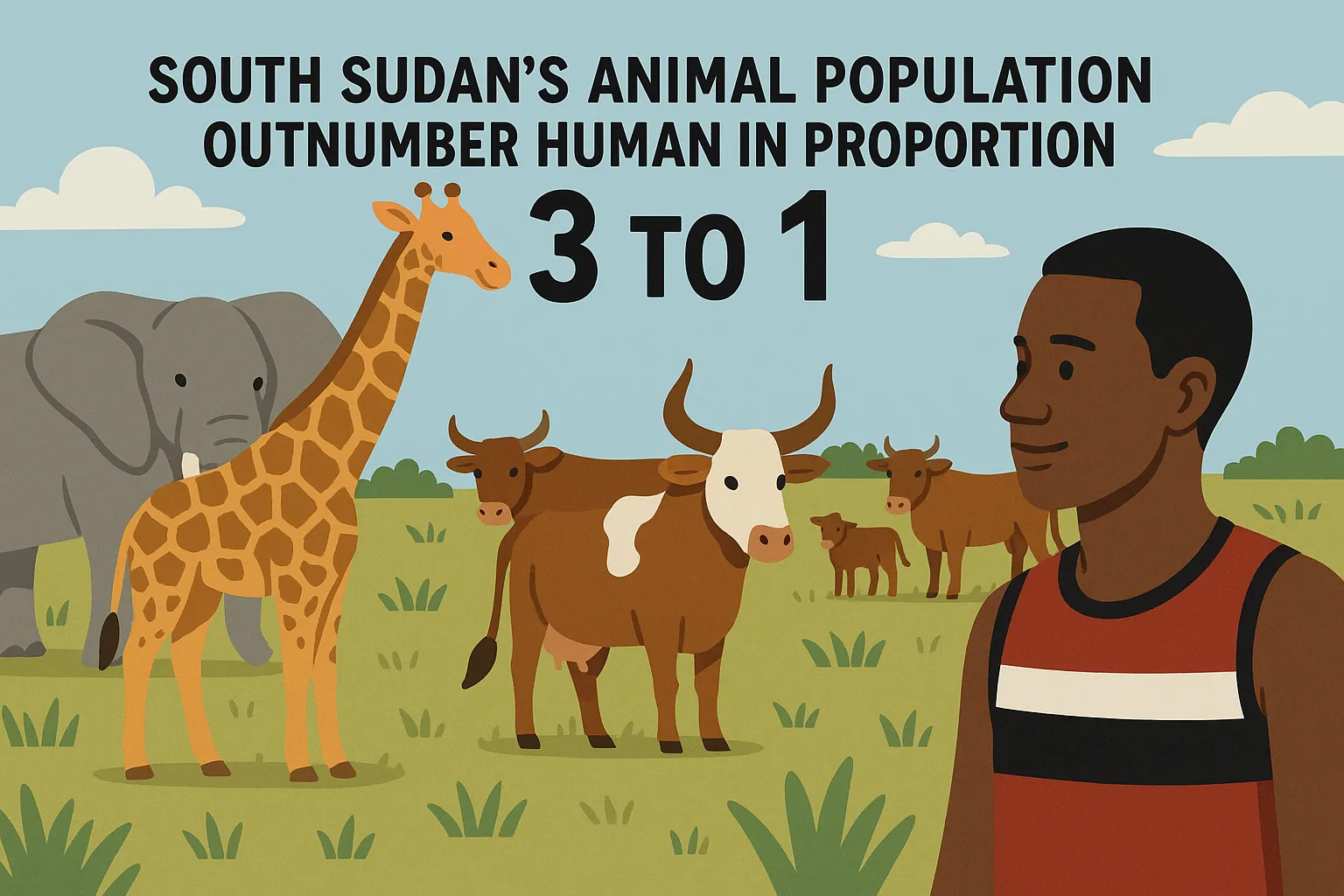
In a striking illustration of South Sudan’s deep agrarian roots, the country’s livestock population has been reported to significantly outnumber its human population by nearly three to one.
South Sudan, officially the Republic of South Sudan, is a landlocked country in East Africa. It is bordered on the north by Sudan; on the east by Ethiopia; on the south by the Democratic Republic of the Congo, Uganda and Kenya; and on the west by the Central African Republic. South Sudan’s diverse landscape includes vast plains and plateaus, dry and tropical savannahs, inland floodplains, and forested mountains. The Nile River system is the defining physical feature of the country, running south to north across its center, which is dominated by a large swamp known as the Sudd. South Sudan had a population of just over 12.7 million in 2024. Juba is the capital and largest city.
South Sudan has a significantly larger livestock population than human population. Estimates indicate around 36.2 million livestock (cattle, goats, and sheep) compared to a human population of roughly 12.19 million. This means there are more than three times as many livestock as humans in the country.
According to recent estimates, South Sudan is home to approximately 11.7 million cattle, 12.4 million goats, and 12.1 million sheep, totalling 36.2 million livestock. In contrast, the country’s human population is estimated at approximately 12.19 million, based on data from the United Nations and the World Bank.
The figures highlight the central role of livestock in South Sudan’s economy and culture. Cattle, in particular, are not only a source of food and income but also serve as a symbol of wealth, social status, and even play a role in traditional marriage customs.
“This livestock-to-human ratio is among the highest in the world,” noted a development expert with knowledge of agricultural demographics in the region. “It reflects both the resilience and the vulnerability of the South Sudanese people, whose livelihoods are closely tied to the well-being of their animals.”
Livestock production contributes significantly to South Sudan’s GDP and remains one of the few stable sectors in a country that has faced years of conflict and economic instability. However, challenges such as animal disease outbreaks, poor veterinary services, and limited market access continue to hamper the full potential of the sector.
Development organizations have increasingly turned their attention to improving animal health services, boosting market infrastructure, and strengthening pastoral resilience, especially in the face of climate change and conflict-driven displacement.
The data offers a compelling reminder: in South Sudan, to understand the people, one must also understand their animals.
