


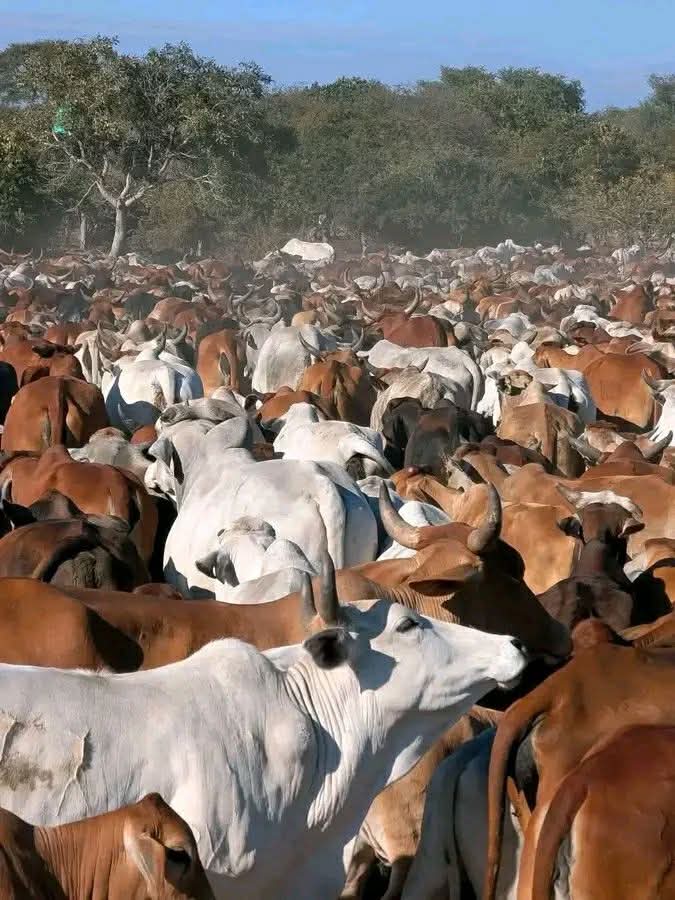
The Federal Government and the African Union–Inter-African Bureau for Animal Resources (AU-IBAR) are collaborating to strengthen safe and market-linked livestock mobility across the African region.
The partnership also aims to create a system where livestock movement is safe, orderly and economically beneficial.
The Minister of Livestock Development, Idi Maiha, stated this on Thursday at the Continental Learning Forum on Market-Linked Transhumance Models in West Africa, held in Abuja.
The theme of the forum is “Strengthening Safe, Orderly, and Market–Linked Livestock Mobility through Evidence, Cross–Regional Learning, and Investment Partnership.”
Maiha said the presence of key stakeholders underscored a shared commitment to building a resilient livestock sector in West Africa.
He noted that Nigeria’s livestock sector was undergoing strategic transformation under the Renewed Hope Agenda of President Bola Tinubu.
The minister said the creation of the Federal Ministry of Livestock Development by President Tinubu demonstrated the country’s renewed determination to develop the livestock sector and expand its contributions to national growth.
“The goal is to increase productivity by strengthening veterinary services, improving animal breeds and stimulating private-sector investment along the entire value chain,” he said.
Maiha added that AU-IBAR was implementing several initiatives that were positively impacting the livestock sector not only in Nigeria but across Africa.
He reaffirmed Nigeria’s readiness to learn, collaborate and partner with countries in West and Central Africa—and the wider continent—for shared growth and prosperity.
“The potential of the livestock industry is enormous, and the future of its development in West Africa depends on our collective ability to build systems that are scientifically sound, economically viable and socially inclusive.
“Together, we can shape a West Africa where pastoral mobility strengthens markets, where veterinary systems protect livelihoods, and where livestock development contributes to national and continental progress,” he said.
In her remarks, the Director of AU-IBAR, Dr. Huyam Salih, said the theme of the forum reflected the evolving needs and realities of pastoral systems across Africa. She was represented by Prof. Ahmed Elbeltagy, Policy Pillar Lead for African Pastoral Markets Development.
Salih said the forum sought to transform pastoral corridors into economic corridors—where livestock movement is safe, disease-control systems operate across borders, and information flows efficiently.
She noted that the ECOWAS Transhumance Protocol and the 2018 Regulation on Transhumance provided one of the continent’s most advanced legal frameworks for regulated cross-border livestock mobility.
However, she said implementation remained uneven due to coordination gaps, insecurity, fragmented policies and inadequate investment in market systems aligned with mobility.
She stressed that the forum was not only about policy analysis but about shaping the future.
“It is about ensuring that mobility is not seen as a problem to be controlled, but as an economic and ecological system that must be strengthened, formalized and linked to markets.
“It is about transforming pastoral corridors into economic corridors, where livestock movement is safe, where disease-control systems function across borders, and where pastoralists and private-sector actors benefit from predictable rules and well-functioning markets,” she said.
