


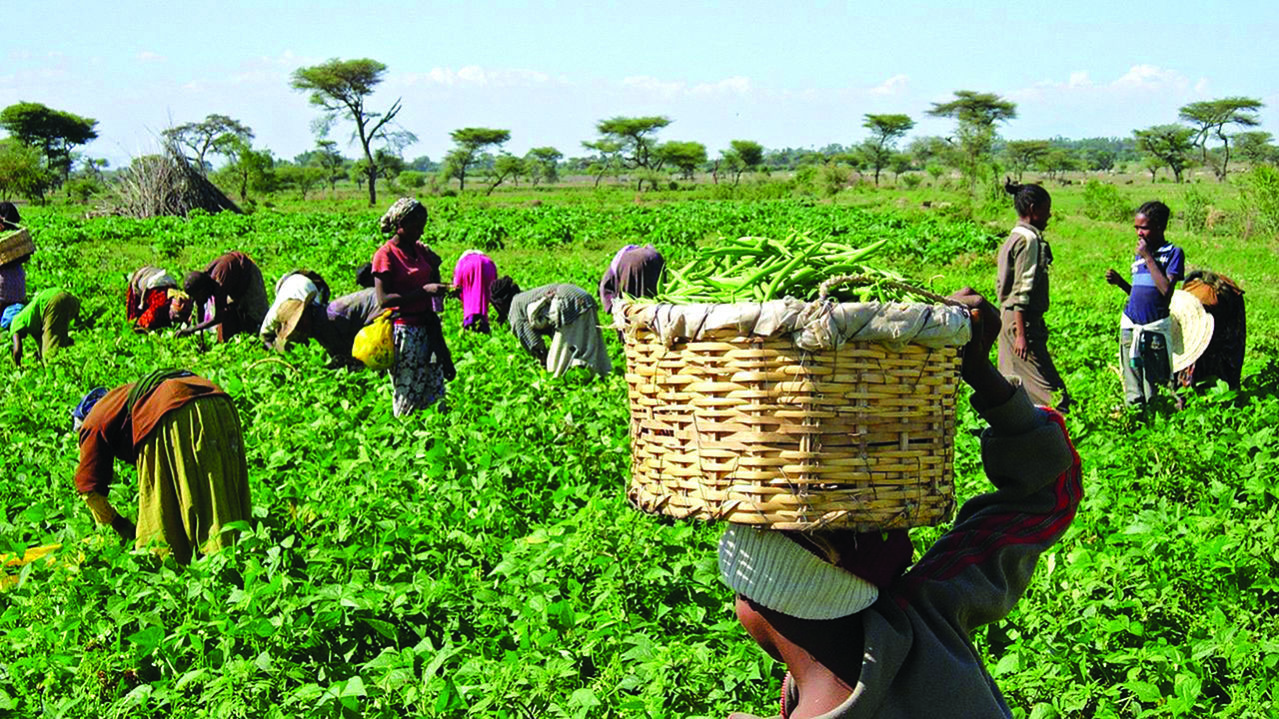
The Federal Government has urged Nigerian farmers to drive an agricultural revolution through local processing and export-oriented production to accelerate economic diversification.
The Deputy Speaker of the House of Representatives, Mr Benjamin Kalu, made the call on Thursday in Abuja while delivering the opening address at the General Assembly of the All Farmers Association of Nigeria (AFAN).
The General Assembly of Farmers (GAF) serves as a national platform to strengthen collaboration among farmers, government, private sector actors and development partners, while reinforcing AFAN’s role as a unified national voice for farmers.
Kalu said the Federal Government, under President Bola Tinubu’s Renewed Hope Agenda, remained committed to ensuring food security for all Nigerians.
He noted that the Central Bank of Nigeria’s 2026 Macroeconomic Outlook projected agricultural GDP growth of between 3.5 per cent and 4.5 per cent, driven by increased investment in farming inputs, extension services and post-harvest infrastructure.
The Deputy Speaker stressed that such growth would be meaningless if it benefited only large-scale operators while millions of smallholder farmers remained trapped in subsistence farming.
“The challenge is not merely to grow agriculture, but to grow agriculture inclusively,” he said.
According to him, the Tinubu administration has repositioned agriculture as a strategic national priority, adding that the removal of fuel subsidies, though difficult, had freed up resources for agricultural mechanization, input distribution and rural infrastructure.
He said the declaration of a national state of emergency on food security, alongside the implementation of the Agricultural Promotion Policy (APP) and the Presidential Fertilizer Initiative (PFI), was beginning to yield tangible results across key production zones.
“I commend this administration for the political courage required to implement these reforms. Easy policies do not create transformation; they create illusion,” Kalu said.
He emphasized that Nigeria’s agricultural revolution would be driven largely by productivity gains among over 40 million smallholder farmers.
“A smallholder farmer who increases yield by 50 per cent, from 1.5 tonnes per hectare to 2.25 tonnes per hectare, contributes more to national output than a single large estate increasing production from 10 to 15 tonnes per hectare,” he said.
According to him, productivity gains among smallholders generate wider employment, strengthen local economies and promote national stability.
Kalu applauded AFAN for convening the Assembly and urged the association to remain a strong voice for farmers in policy discussions, while ensuring that improved cultivation practices and post-harvest systems are embedded in all agricultural programmes.
He observed that Nigeria currently exports about 3 billion dollars (₦4.44 trillion) worth of agricultural produce annually, mainly cocoa, cashew and sesame.
He added that Côte d’Ivoire earns over four billion dollars annually from cocoa exports alone, while India generates more than 40 billion dollars from total agricultural exports.
“We export raw cocoa, not chocolate. We export unprocessed cashew, not finished products. We export sesame seeds, not sesame oil,” he said.
Kalu said a strategic focus on value addition and export diversification could create millions of jobs and generate more than 10 billion dollars in foreign exchange earnings within five years.
He urged AFAN members to invest in processing, export-quality production and access to international markets, assuring them of policy and partnership support.
He also called on state governments to allocate at least five per cent of their budgets to agricultural infrastructure and urged the private sector to invest more boldly in processing, logistics and market systems.
Nigeria’s future, he said, is inseparable from agriculture, noting that every job created in the sector feeds a household and strengthens national cohesion.
“We have the resources. We have the policy environment. What we need is unified will,” he said.
Earlier, the National President of AFAN, Dr Farouk Rabi’u-Mudi, said the theme of the Assembly, “Empowering Farmers, Fostering Collaboration,” reflected the core objectives of the gathering.
He said AFAN, as the umbrella body for farmers nationwide, played a strategic role in ensuring that agricultural policies and investments addressed farmers’ realities.
Rabi’u-Mudi identified key challenges facing the sector as weak institutional coordination, limited access to finance and inputs, inadequate extension services and low adoption of innovation.
He said the Assembly was designed to strengthen collaboration among stakeholders and reposition farmers at the centre of Nigeria’s agricultural transformation.
It was reported that the highlight of the opening day of the three-day General Assembly was the presentation of an award to the Deputy Speaker in recognition of his contributions to agricultural development in Nigeria.
