


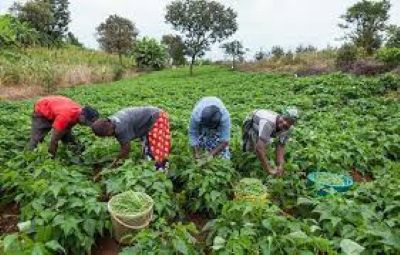
The Federal Government has urged financial institutions to develop tailored products that help farmers adopt low-emission, climate-smart practices to ensure cleaner air, healthier communities, resilient food systems, and a more climate-secure Nigeria.
Dr Marcus Ogunbiyi, Permanent Secretary of the Federal Ministry of Agriculture and Food Security (FMAFS), made the call on Thursday at the Close-Out Workshop of the Abatement of Short-Lived Climate Pollutants (ASLCP) in the Nigerian Agricultural Sector held in Abuja. The meeting also served as the Final Project Dissemination of ASLCP.
The ASLCP project in the Nigerian agricultural sector focused on reducing open-field burning and was convened under the theme: “Local Action, National Impact: Building Resilience through Climate-Smart Agriculture.”
Ogunbiyi urged extension agents and farmers to remain ambassadors of no-burn agriculture and resilient farming systems, while calling on development partners to support scale-up initiatives, longer implementation horizons, and results-based financing models.
“The event marks an important milestone in Nigeria’s collective effort to confront climate change through practical, farmer-centred, and scalable agricultural solutions, particularly in reducing short-lived climate pollutants that pose immediate risks to our environment, health, and food systems.
“This project, implemented by Self Help Africa in collaboration with the FMAFS with funding from the Climate and Clean Air Coalition (CCAC), exemplifies the power of strategic partnerships in translating global climate commitments into local action. As we conclude this project phase, our collective responsibility is to sustain, institutionalize, and expand its gains,” he said.
Ogunbiyi explained that the project covered all six geopolitical zones of the federation, with a major demonstration site in Gboko Local Government Area, Benue State. Farmers successfully adopted improved climate-smart agricultural practices across 20 demonstration plots in 15 communities, including water-efficient rice production methods that reduce methane emissions, climate-resilient cowpea cultivation techniques, sustainable residue management, mulching practices to replace open-field burning, and locally fabricated briquette-making technologies that convert agricultural waste into clean energy.
“The project achieved measurable behavioral change. Farmers moved away from traditional burning practices and embraced conservation agriculture techniques that protect soil health, improve yields, and reduce emissions. These demonstration plots have since evolved into community learning centres, strengthening peer-to-peer knowledge transfer and ensuring local ownership of climate-smart innovations,” he said.
Ogunbiyi highlighted black carbon from open-field burning and methane from rice cultivation and livestock systems as among the most potent contributors to near-term global warming.
“Though their lifespan in the atmosphere is short, their warming impact is significantly higher than carbon dioxide, with serious consequences for air quality, human health, and agricultural sustainability. For Nigeria, where agriculture remains central to livelihoods, employment, and food security, addressing Short-Lived Climate Pollutants presents a unique triple-win opportunity to slow near-term climate warming, improve air quality and public health, and strengthen agricultural productivity and resilience.
“This project has convincingly demonstrated that climate mitigation, adaptation, and food security can be pursued simultaneously, not in isolation,” Ogunbiyi added.
He noted that the workshop provided a platform to reflect on lessons learned, share experiences, and explore pathways for scaling up successes. “The outcomes are highly relevant to national priorities, including Nigeria’s Nationally Determined Contributions, long-term low-emission development strategies, and the broader agricultural transformation agenda.”
Ogunbiyi urged policymakers, development partners, financial institutions, researchers, extension agents, and farmers to focus on institutionalizing gains, strengthening partnerships, and mobilizing support to sustain and expand SLCP mitigation efforts in agriculture. He also commended the Climate and Clean Air Coalition for its timely intervention, noting that the project demonstrated that effective climate action is achievable at the community level with farmers as active contributors.
Mr Oshadiya Olanipekun, Director, Department of Agricultural Land and Climate Change Services (ALCCMS), said the workshop marked an important milestone in translating climate commitments into practical actions.
“Short-lived climate pollutants, including methane and black carbon, pose serious risks to our climate, air quality, and public health. In Nigeria, where agriculture is a major economic driver and significant emissions source, addressing SLCPs offers a unique opportunity to reduce global warming, improve environmental health, and enhance agricultural productivity.
“Over the course of this project, particularly in Gboko LGA and across the six geopolitical zones, farmers adopted improved practices in rice and cowpea production, sustainable crop residue management, and alternatives to open-field burning, including locally fabricated briquette technologies. These interventions not only reduced emissions but also strengthened resilience and livelihoods at the community level,” he said.
Mrs Joy Aderele, Country Director, Self Help Africa, said the project has demonstrated practical and scalable no-burn alternatives that reduce black carbon and other short-lived climate pollutants while improving soil health, farm productivity, and farmer livelihoods.
“Today’s meeting provides an important platform to share results, lessons learned, and field experiences, and to collectively reflect on strategies for sustaining and scaling no-burn practices beyond the life of this project,” she said, commending Ogunbiyi for his guidance and collaboration in advancing climate-smart agriculture and sustainable land management across project communities.
