


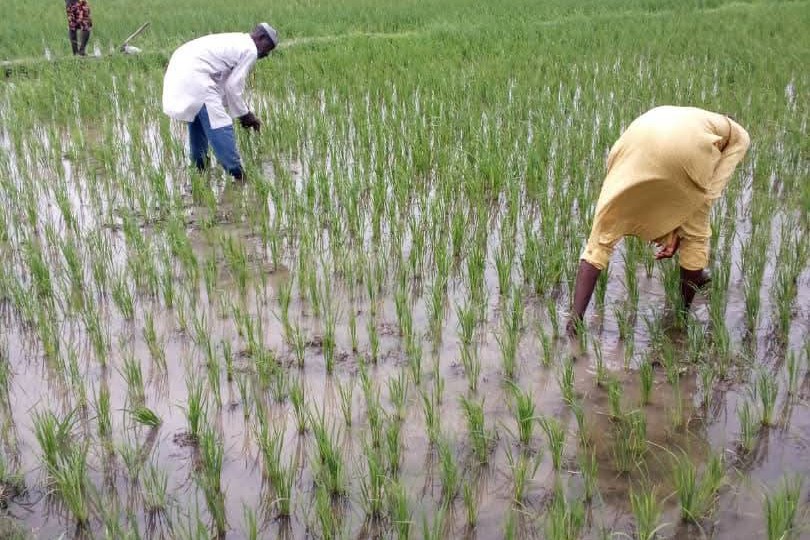
Some agriculture experts have urged local rice farmers to continue cultivating the crop despite the increase in rice imports into the country.
The experts made the call in separate interviews with reporters on Tuesday in Lagos.
A recent survey in early January showed that over 3,500 rice farmers are set to pull out of cultivation due to losses estimated at N93 billion across the sector during the 2025 wet season.
The findings were contained in the 2025 Major Wet Season Impact Report released by the Presidential Food Systems Coordinating Unit.
An agricultural communication expert, Dr Ismail Olawale, urged the government to address the factors putting local farmers at a disadvantage.
“There are many indices that may influence rice farmers dumping the cultivation of the produce for other crops, aside from the importation of rice.
“If we are going to get exactly what is actually frustrating these farmers to abandon the planting of rice in the next season, then it shouldn’t be anchored only on the importation granted by the Federal Government.
“No matter how much produce is imported, if we have local ones that are viable and appropriately competing with the imported ones, it will be better for consumers and the country.
“It gives Nigerians the authority of preference and choice,” Olawale said.
The expert also noted that there were many behind-the-scenes activities affecting the sector.
He listed challenges such as hoarding and the proliferation of Nigerian rice across borders to other African countries.
“We are encouraging rice farmers to keep on farming despite the indices or whatever disadvantages—we need our own local produce.
“Farmers are at the bottom and the receiving end of this, but they have to be encouraged.
“If we are going to encourage them, we must tighten up some of these indices that are now going to be investigated through surveys or any other analysis,” he said.
On his part, an agriculture analyst and farmer, Mr Omotunde Banjoko, urged the government to consider better options for addressing food inflation aside from food importation.
“If local rice farmers are quitting, then the implication is that if the matter is not addressed, we might end up having a shortage at some point because importation is not sustainable.
“So, what we need to do is what we’ve been advocating for. The government should look at a better approach to reducing food prices, which is addressing the cost of farm inputs primarily rather than importation as a source of bringing down prices.
“So, it’s not only the rice farmers—all farmers who are into production are complaining because now we are selling at a loss below our cost of production.
“We need to address the farmers’ cost of production in whatever direction we are taking,” Banjoko said.
