


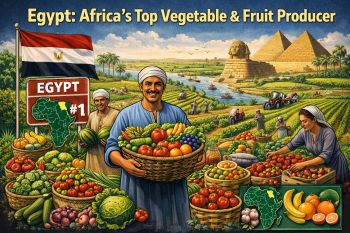
Egypt has emerged as Africa’s leading vegetable and fruit producer, topping continental output for key staples such as wheat, tomatoes, onions, potatoes, cucumbers, garlic, oranges and sugar beet, and ranking among the top producers for several other crops, despite having one of the smallest arable footprints on the continent.
Main production claims: What the data shows
Based on recent Food and Agriculture Organisation (FAO) and sector analyses (covering roughly 2017–2024), the following elements of the viral claim hold broadly:
Wheat: Egypt is the largest wheat producer in Africa, with annual output around 9–10 million tonnes in recent years, surpassing Ethiopia and accounting for roughly 17% of continental wheat production.
Tomatoes: Egypt leads Africa in tomato output, harvesting over 6 million tonnes in 2022 and holding the top position for over six decades according to FAO‑tracked data.
Dry onions and garlic: Egypt is Africa’s top producer of both dry onions and garlic, with garlic production estimated at about 500,000 tonnes in 2024, double that of Algeria and Ethiopia combined.
Potatoes and cucumbers: Egypt ranks as Africa’s largest producer of potatoes and cucumbers, with substantial volumes driven by irrigation‑intensive farming along the Nile Delta and reclaimed lands.
Oranges: Egypt is Africa’s leading producer and exporter of oranges, with annual output close to 3.7 million metric tonnes, ahead of traditional citrus powers such as South Africa.
Sugar beet: Egypt stands among Africa’s top sugar‑beet producers, expanding cultivated area to over half a million feddans (about 215,000 hectares) to support a new beet‑sugar industry targeting domestic supply and exports.
Several of the secondary rankings in the viral claim are directionally accurate but harder to verify as strictly “2nd highest” across all years:
Cabbages, grapes, lemons, mangoes: Egypt is a major producer of cabbages, grapes and lemons and ranks among the top two in Africa for mangoes, though exact “2nd highest” status can vary by year and data source.
Maize and carrots: Egypt is often among the top ten African producers of maize and carrots, with recent data placing it about 4th in maize and 5th in carrots, but minor shifts in acreage or yields can alter these positions year‑to‑year.
Land constraint: Desert vs arable reality
The claim that Egypt’s arable land is about 3.5 million hectares and the 13th smallest among African countries aligns with common summaries in African‑focused data pages and social‑fact posts, though definitions of “arable” can differ slightly between FAO and national sources.
Egypt’s high‑ranking crop output is especially striking given that nearly 96% of its territory is classified as desert, forcing agriculture to concentrate along the Nile Valley and Delta and in newly reclaimed desert lands. Technological upgrades, expanded irrigation schemes, and intensive cropping patterns have allowed Egypt to punch far above its land‑size weight in continental production tables.
Caveats and context
The “2017–2024 average” label is not yet formally published as a single FAO‑style dataset but is consistent with trended annual figures from commodity reports and continent‑level rankings.
Some secondary rankings (e.g., “2nd highest” for cabbages, lemons, mangoes) are plausible but should be treated as approximate, given that many African countries report with limited frequency or granularity.
What this means for food security and trade
Egypt’s dominance in vegetables and fruits underpins not only domestic food security but also a growing export footprint into Europe, the Middle East and emerging Asian markets. Simultaneously, Egypt remains the world’s largest wheat importer, highlighting the structural gap between its strong domestic production and its massive consumption needs.
In practical terms, the viral claim is broadly accurate: Egypt produces the highest volumes of wheat, tomatoes, onions, potatoes, cucumbers, garlic, oranges and sugar beet in Africa and ranks among the top two producers for several other staples, all from a relatively tiny and mostly desert‑constrained arable base.
