


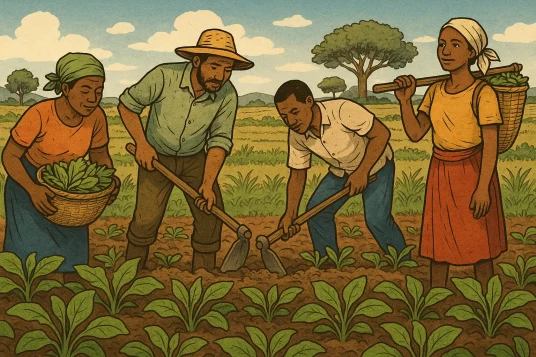
The Commodity Leaders Empowerment Network for School Feeding (CLENSFe), an NGO, has demonstrated its commitment to empowering smallholder farmers by connecting them with school feeding programmes.
Mr Danladi Ibrahim, a consultant to the NGO, was committed while electing committee members of the organisation in Abuja on Friday.
Ibrahim said that the programme aimed to ensure a sustainable food supply for students, as well as boost local economies.
He said that the programme entailed sourcing food from local farmers to schools to provide nutritious meals for students and also create a reliable market for farmers.
According to him, it also involves increasing the income of the farmers and promoting local economic growth.
“The NGO, which is also known as a commodity association, is set to empower smallholder farmers because we have realized that it is one of the ways to promote agriculture.“
What we are doing is to source for the farmers and link them to government statutory feeding initiatives.“For instance, we have students who are being fed in various government boarding schools, we have to engage these farmers who will be supplying food directly to them,” he said.
Ibrahim said that the organisation would also extend the programme to other institutions like the Nigerian Correctional Service (NCS), by providing food to prison inmates.
“We are also considering the Internally Displaced Persons (IDPs) camps and military institutions.“What we are planning to do is to see how these farmers can be empowered through this supply chain,’’ he said.
He said that the programme would work through Farmers, Agriculture, Digital, and Empowerment (FADE), adding that the effort will strongly enhance the programme’s effectiveness.
“It is a farmers’ digital village initiative programme designed to transform rural areas in Nigeria through digital technology, focusing on enhancing agricultural productivity and farmer livelihoods.“
The initiative aims to integrate digital tools and technologies into various aspects of agriculture, including precision farming, market linkages, financial services and access to information.
Mr Bukar Jibrin, the newly elected National Coordinator of the NGO, said that the aim was to reduce reliance on external suppliers and to support the local economy.
Jibrin called on the organisation to be committed to ensuring the CLENSFe achieved its mandates.
Mr Adjarho Oghenekaro, Member, Board of Trustees (BoT), said that the programme would help smallholder farmers increase their income and improve their livelihoods.
Oghenekaro said that the school feeding programme would ensure that students receive healthy, locally-sourced meals, contributing to their overall well-being and academic performance.
“We want to be sure that what the students are eating is genuine and organic.“What we are planning is a community association that produces food through the farmers and supplies to the schools.
“We are trying to make sure that any food the students eat has a traceable line from the farmers, so that the government will buy from the farmers directly and not from any other source,” he said.
Dr Chinedu Amadi, the newly elected National Deputy Coordinator of the organisation, said that the programme was a national initiative that covered the country.
Amadi said the organisation was collaborating with some Ministries, Departments and Agencies (MDAs), and other relevant stakeholders to ensure that the NGO achieved its objectives and mandates effectively.
