


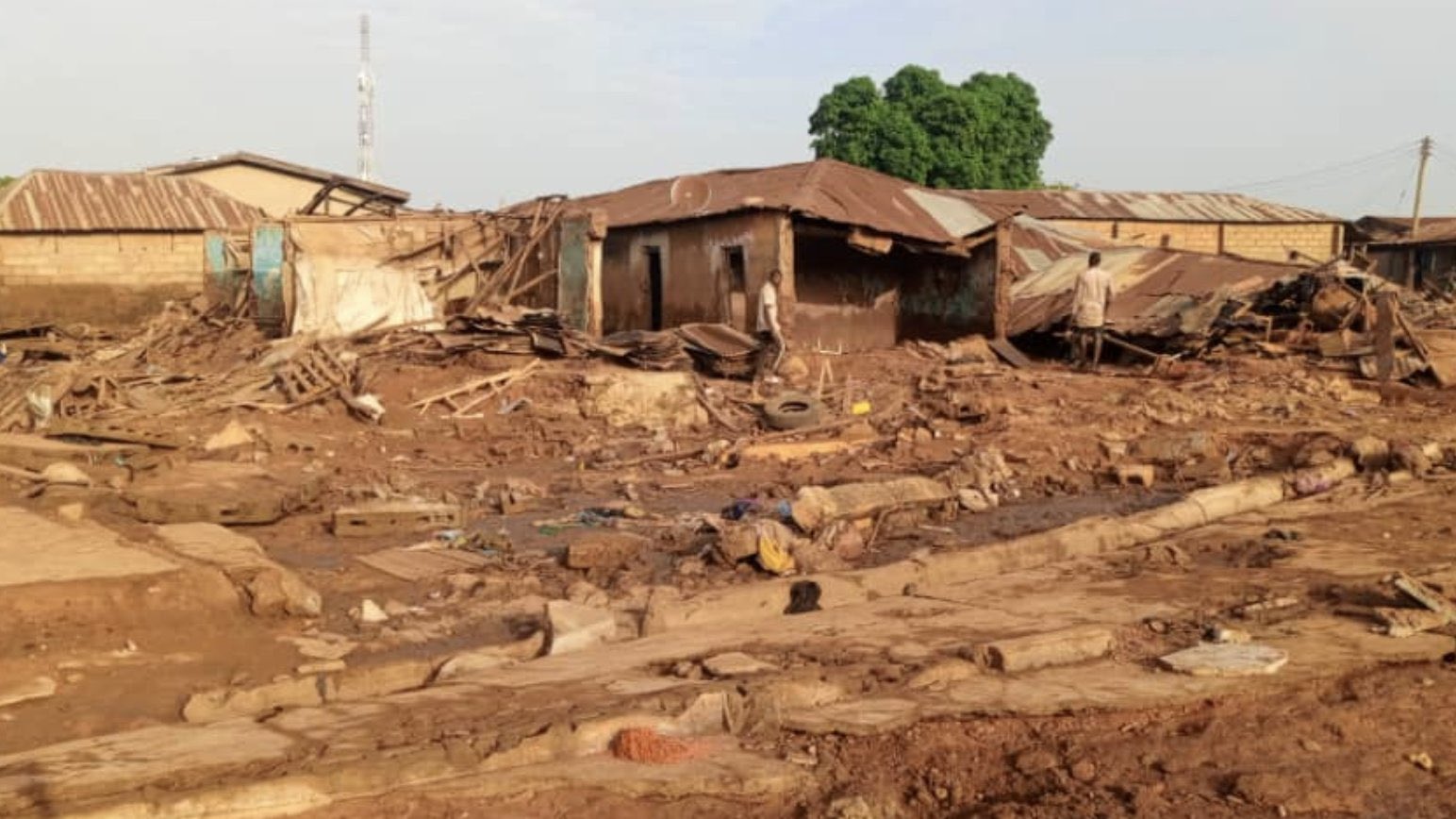
The smell of wet earth and loss lingers in the air. In Mokwa, Niger State, the flood didn’t just come with water—it came with sorrow. It came like a thief in the night, swallowing homes, silencing laughter, and leaving behind the haunting stillness of a town in mourning.
At least 151 people have died. More than 3,000 are now homeless. But behind these numbers are real stories—mothers searching for their children, fathers trying to rebuild with bare hands, and children who wake up crying in strange shelters, asking when they can go home.
But there is no home anymore.
“I Watched It Take Everything”
Musa Tanko, a farmer and father of six, now sits under a makeshift tent made from old plastic sheets and broken sticks. Just a few days ago, he had a home—a small house built with love and hope. A home filled with the sound of his children running around, his wife humming as she cooked. All of it is gone.
“I watched it take everything,” he says, his voice low, staring into the distance. “The water came too fast. I couldn’t save my daughter. I couldn’t save my wife. I buried them with my hands. I don’t even know where to begin again.”
His 9-year-old son clutches his arm tightly. The boy hasn’t spoken since the flood.
Life turned inside out
In the heart of Mokwa town, what used to be homes are now piles of broken wood, crumbled mud walls, and scattered memories—shoes without owners, school books turned to pulp, cooking pots lying upside down in the mud.
People wander through the wreckage, looking for anything to salvage—a piece of clothing, a family photo, maybe a sign that not everything is lost.
For women like Hadiza Salihu, survival has taken on a new meaning.
“We don’t even have water to drink,” she says, carrying her toddler on her back, standing near one of the temporary shelters set up at a school compound. “At night, the children cry from hunger, from cold, from fear. How do you explain this to a child?”
ALSO READ EDITORIAL: Rains Arrive, Panic Grips Communities
The helpers and the hope
Relief has trickled in. The Niger State Emergency Management Agency (NSEMA) and the National Emergency Management Agency (NEMA) were among the first responders, bringing food, blankets, and medical supplies. Hydroelectric Power Producing Areas Development Commission (HYPPADEC), the agency charged with supporting hydroelectric host communities, has been on the ground as well, assessing damage, assisting evacuations, and offering support.
But the needs are overwhelming. Aid workers confess they are short on supplies, with no clear timeline for when proper relief will reach everyone.
President Bola Tinubu has ordered action on the Mokwa flood:
“Upon receiving initial reports, I immediately directed the activation of the National Emergency Response Centre. I have also been briefed by the National Emergency Management Agency (NEMA) on the scale of the disaster and the urgent humanitarian needs.”
On Saturday, the Niger State Deputy Governor, Yakubu Garba visited Mokwa and assured the flood victims of adequate attention.
A tired NSEMA official, clearly stretched thin, said:
“We are trying our best, but we need more hands. We need more resources. We need more attention on Mokwa.”
The HYPPADEC, in a statement by its spokesperson, Nura Tako Wakil, has appealed to all levels of government, as well as individuals and organizations, to swiftly support those affected by the disaster.
“We call on all relevant stakeholders to take urgent action in providing relief and assistance to cushion the impact of this tragedy on the affected communities.
But will words of sympathy and encouragement solve the future occurrences of floods in other parts of the country? Shouldn’t the Nigerian government take preventive measures to avert floods in the country?
Indeed, while Mokwa drowns in floodwater and grief, much of the country has moved on. But for the people here, time is frozen.
Why must we keep dying like this?
This isn’t the first time Mokwa has suffered flooding, and likely won’t be the last. Every year, residents brace for the rains with anxious hearts. Promises are made. Visits are paid. But when the water comes, they are always alone.
Community leader Alhaji Umar Sidi puts it bluntly:
“Why must we keep dying like this? Why haven’t we been relocated? Why is there no dam, no embankment, no permanent solution? We are citizens too. We are not asking for luxury—just to live without fear.”
What must be done—with urgency and heart
What Mokwa needs now is not pity. It is action. Deliberate, sustained, and humane action.
Immediately:
The federal government must declare a state of emergency to unlock faster and wider support.
Health and sanitation infrastructure must be set up in the temporary camps to avoid a second tragedy from disease outbreaks.
Relief must go beyond rice and beans—it must include psychosocial support, clean water, clothing, and dignity.
In the long term:
A comprehensive resettlement plan must be designed and implemented for flood-prone areas.
Flood defense infrastructure, including dams and drainage systems, must be prioritized.
Community-based disaster education and response units must be funded and trained.
The spirit of Mokwa endures
In the face of all this pain, the spirit of Mokwa still refuses to die.
Young men volunteer as makeshift rescue workers, helping the elderly to safety. Women share what little food they have. Children, even in grief, draw images in the sand of the homes they once had, whispering dreams of rebuilding.
Faith leaders lead prayers in the camps each night. And in the silence between the sobs and the hunger, there is hope—fragile, yes, but still alive.
Because Mokwa is more than its ruins.
It is its people. Their courage. Their stories. Their will to live.
If we fail to act now—not just with money, but with compassion, with justice, and with resolve—then we are choosing to let this happen again. And again. And again.
Mokwa weeps.
Nigeria must listen.
And the world must not look away.
