


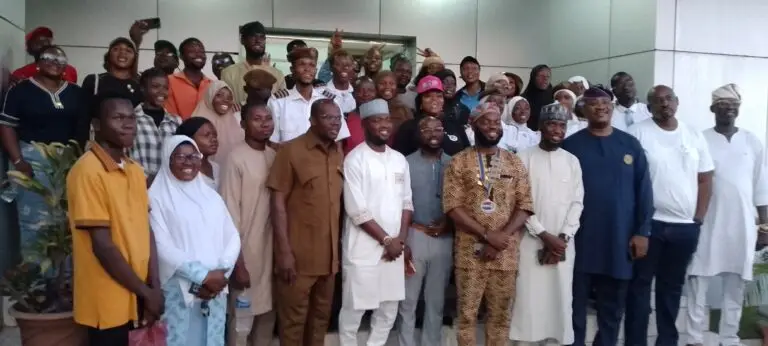
The Rotary Club of Ilorin Metro, the Kwara State Environmental Protection Agency (KWEPA) and the Rural Water Supply and Sanitation Agency (RUWASA) have agreed to partner to improve Water, Sanitation and Hygiene (WASH) in communities across the state.
This was the resolution reached during a panel discussion organised by the Rotary Club on Saturday in Ilorin.
In his address, the President of the Rotary Club of Ilorin Metro, Mr. Buhari Oladimeji, said the initiative aims to address the pressing issues of access to clean water and proper sanitation facilities, particularly in underserved areas.
Oladimeji said there is a need for initiatives that promote the construction and rehabilitation of water infrastructure, including boreholes and sanitation facilities, in schools and communities.
He noted that this aligns with Rotary International’s goal of providing access to clean water and sanitation for all.
The President said the Rotary Club of Ilorin Metro, RUWASA and KWEPA would work together to improve the health and wellbeing of communities, with a focus on vulnerable groups such as women and children.
Speaking during the panel discussion, the General Manager of RUWASA, Mr. Olorunfemi Oladipo, said access to WASH facilities is a fundamental right of citizens.
Oladipo emphasised that WASH facilities must be available in all schools, especially in girls’ schools due to menstrual hygiene needs.
According to him, although the state government has been providing WASH facilities, the maintenance culture remains poor.
“We need advocacy and community engagement to sensitise people on the importance of taking ownership of WASH facilities,” he said.
On his part, the General Manager of KWEPA, Mr. Jide Aina, said environmental challenges persist in the state.
He noted that agency workers face insecurity, with some being attacked in the course of their duties.
“There is a lack of awareness of laws relating to environmental protection and public health,” he said.
Aina urged security agencies to support government efforts in enforcing environmental sanitation laws.
He also underscored the importance of Public-Private Partnerships (PPP) in promoting a clean environment and urged organisations to emulate Rotary in supporting WASH initiatives.
Similarly, Dr. Opasola Afolabi, an Environmental Health Scientist at Kwara State University (KWASU), said the poor maintenance of WASH facilities is largely due to a lack of community ownership.
“It is cheaper to build toilets but more expensive to maintain them because there is no sense of ownership,” he said.
He also emphasised the need for proper data interpretation on WASH in the state.
According to him, the United Nations Children’s Fund (UNICEF) and the World Health Organisation (WHO) recommend at least one toilet for 50 boys and one for 25 girls, alongside adequate WASH facilities.
Earlier, in his goodwill message, the District Governor of Rotary Club, Mr. Funkeapko Ken Batife, commended members for their progressive actions in communities.
He reiterated the organisation’s commitment to continue providing development-oriented and selfless services to communities across the country.
