


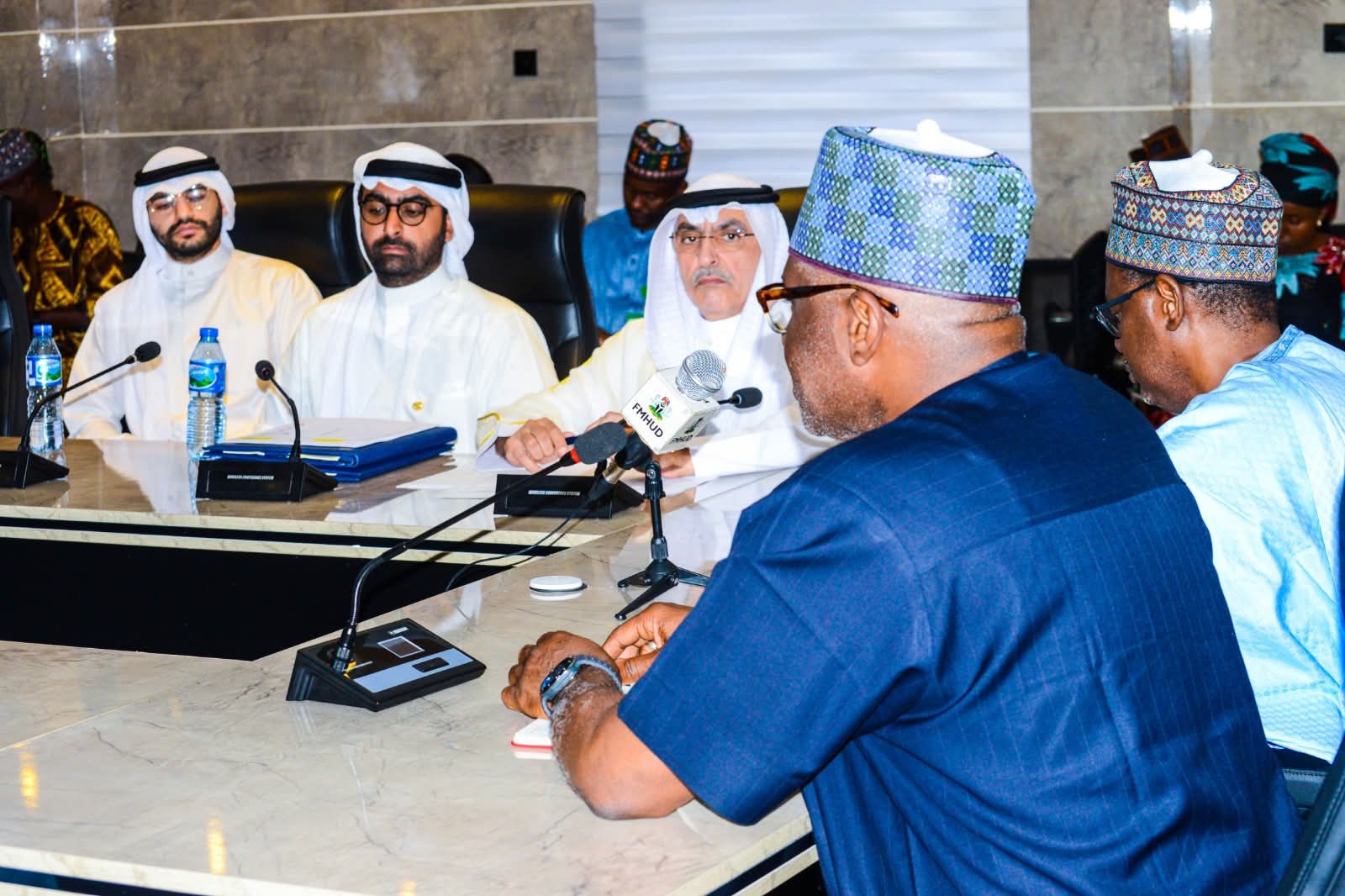
The Federal Ministry of Housing and Urban Development is seeking strategic collaboration with the Kuwait Fund for Arab Economic Development (KFAED) to drive Nigeria’s affordable housing agenda and bolster infrastructure development across urban and rural communities.
Speaking during a high-level meeting with a visiting KFAED delegation in Abuja, Minister of Housing and Urban Development, Arc. Ahmed Musa Dangiwa, outlined key intervention areas, including building materials manufacturing hubs, slum upgrading programs, the Renewed Hope Social Housing initiative, and the development of infrastructure in the planned Centenary City.
Dangiwa emphasized the Ministry’s commitment to creating enabling environments for investment, particularly under President Bola Ahmed Tinubu’s Renewed Hope Agenda, which targets large-scale delivery of affordable and dignified housing for Nigerians.
“Our focus is on affordable housing and the promotion of sustainable urban development. We welcome technical and financial assistance to enable these programs take shape,” Dangiwa said.
Key projects and funding needs
The Minister highlighted the Ministry’s plan to establish Building Material Manufacturing Hubs in all six geopolitical zones, each sited on 200 to 300 hectares and fully equipped with roads, water, electricity, and other infrastructure. These hubs aim to reduce the cost of building materials, promote local production, and create jobs.
He also cited the Ministry’s plan to roll out 100 social housing units in each of Nigeria’s 774 local government areas, prioritizing low-income earners, the underprivileged, and displaced persons. According to Dangiwa, 70 percent of these homes will be sold at subsidized rates to low-income earners, while the remaining 30 percent will be allocated to zero-income individuals at no cost.
However, he acknowledged that the social housing program is facing major funding gaps, for which international support is urgently needed.
Additionally, the Minister drew attention to the need for support in the Centenary City project—a 1,200-hectare mixed-use district in Abuja requiring substantial infrastructure to attract private sector developers.
He also appealed for technical assistance to update feasibility studies, noting that while some assessments have been conducted, current and comprehensive data is needed to meet donor and investor expectations.
Kuwait fund’s response
On his part, Director-General of KFAED, Dr. Wahad Al-Bahar, said the delegation’s visit aimed to explore viable areas of collaboration with the Nigerian Government, particularly in infrastructure and social sectors.
“We are here to identify feasible projects we can support. Updated feasibility studies are essential to assess cost implications and viability,” Dr. Al-Bahar stressed.
He clarified that while the Fund does not directly finance housing construction projects, it is open to supporting associated infrastructure like roads, water systems, sanitation, schools, and healthcare services that make housing viable.
Dr. Al-Bahar disclosed that the Fund had recently signed its first Nigerian partnership agreement with Kaduna State for an out-of-school children project. He added that the Fund offers soft loans under favorable terms—with maturity periods of 20 to 25 years and low interest rates—and is willing to provide assistance in developing feasibility studies.
“If you need help developing proper studies, we are willing to support you,” he assured.
He welcomed the Nigerian Housing Ministry’s priority areas and reiterated the Fund’s willingness to consider them once detailed proposals and studies are made available.
