


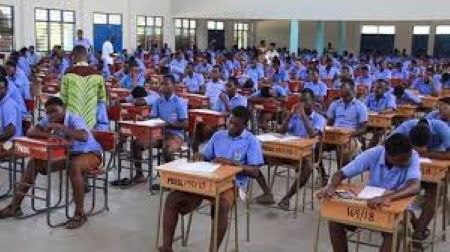
A researcher in education Dr Moses Ogunniran has said that the federal government of Nigeria can use education as one of the tools to combat and reverse insecurity in the North East region if education is properly harnessed .
Speaking in Uyo, Akwa Ibom state capital, Ogunniran listed three states where insecurity has threatened educational future of children to include Borno , Yobe and Adamawa states saying that government can explore education to tackle the situation instead of making it a nightmare
Ogunniran who is an overseas research scholar in education on the topic ” From Target To Trust Zones: How Evidence Based Education Reform Can Secure Nigeria’s Schools” observed that schools in North – East Nigeria have become symbols of national vulnerability as well as centre of violence with casualties .
“Education can be used as one of the most effective tools to fight and reverse insecurity when properly harnessed.
”As Nigeria confronts one of the most protracted internal security crises in its history, schools have increasingly become both symbols of national vulnerability and frontline casualties of violence.
“From Boko Haram’s ideological war against Western education in the North-East to the surge in mass kidnappings linked to banditry in the North-West, classrooms have turned into soft targets, forcing repeated closures, mass displacement of learners, and deepening fear among families”.
“Education can be used as one of the most effective tools to fight and reverse insecurity when properly harnessed.
“According to global evidence synthesized by UNESCO, education; when deliberately designed for conflict settings; can also become one of the most effective tools for reversing insecurity”.
Ogunniran, an education policy researcher and contributing author to UNESCO’s International Science and Evidence-Based Education (ISEE) Assessment and one of the most authoritative global reviewer highlighted how education systems can interact with conflict, violence, and social cohesion to produce desired objective for national development.
Ogunniran who also serves as a coordinating contributing author on the chapter “From Perpetrator to Peacebuilder: Rethinking Education in Conflict-Affected Societies,” produced under UNESCO’s Mahatma Gandhi Institute of Education for Peace and Sustainable Development (MGIEP).
Having Worked with an international team of scholars across social science and neuroscience, Ogunniran said the chapter examines how education can either reproduce violence or deliberately interrupt it through policy design, governance, curriculum, and community engagement.
“Nigeria’s experience illustrates the stakes. Since Boko Haram escalated attacks on education in the early 2010s, the scale of disruption has been severe.
“UNESCO-referenced data show that by 2019 about 802 schools remained closed in the conflict-affected states of Borno, Yobe, and Adamawa, with 497 classrooms destroyed and approximately 1,392 damaged, leaving around 2.8 million children in need of education-in-emergencies support.
”High-profile abductions have further destabilized schooling.
“The 2014 kidnapping of 279 schoolgirls in Chibok and the 2018 abduction of 110 girls in Dapchi exposed the strategic targeting of education, and UNESCO-cited evidence confirms that many of the abducted girls remain in captivity years later.
“Since 2020, banditry-related mass kidnappings have widened the geography of fear, prompting school closures across several states”.
He disclosed that the damage in education system has extended far beyond immediate learning loss in schools as females children have chunk share of out of school children .
In conflict-affected northern states, girls account for a disproportionate share of out-of-school children as families withdraw them due to fears of abduction and sexual violence.
Ogunniran stated that prolonged educational disruption in the affected states entrenches gender inequality, weakens human capital formation and erodes trust in public institutions.
” UNESCO’s global evidence further shows that sustained schooling interruptions increase the likelihood that young people; particularly those facing unemployment and social exclusion—become vulnerable to recruitment into armed or criminal groups.
“In a country with intense demographic pressure, education gaps in one region inevitably generate spillover effects nationwide through displacement, labour-market stress, and social fragmentation’.
Ogunniran maintained that education is not neutral as it operates simultaneously as a victim, a perpetrator, a liberator, and a peacebuilder in a conflict ridden society .
“Schools become victims when they are attacked for symbolising state authority or contested ideologies.
