

• Home
  • Agric
  • Sci & Tech
  • Health
  • Environment
  • Hausa News
  • More
    • Business/Banking & Finance
    • Politics/Elections
    • Entertainments & Sports
    • International
    • Investigation
    • Law & Human Rights
    • Africa
    • ACCOUNTABILITY/CORRUPTION
    • Hassan Gimba
    • Column
    • Prof. Jibrin Ibrahim
    • Prof. M.K. Othman
    • Defense/Security
    • Education
    • Energy/Electricity
    • Entertainment/Arts & Sports
    • Society and Lifestyle
    • Food & Agriculture
    • Health & Healthy Living
    • International News
    • Interviews
    • Investigation/Fact-Check
    • Judiciary/Legislature/Law & Human Rights
    • Oil & Gas/Mineral Resources
    • Press Freedom/Media/PR/Journalism
    • General News
    • Presidency
  • About Us
    • Contact Us
    • Board Of Advisory
    • Privacy Policy
    • Ethics Policy
    • Teamwork And Collaboration Policy
    • Fact-Checking Policy
    • Advertising
  • Media OutReach Newswire
    • Wire News
  • The Stories
Facebook Twitter Instagram
Trending
  • [VIEWPOINT] Why FG Should halt the persecution of Ozekhome, By Echika Ejido
  • Taraba: NAPTIP intercepts trafficker with 10 children
  • FG empowers 40 cooperatives with farm inputs in Yobe
  • PenCom launches online platform
  • Katsina to host 3,750 housing units, aquaculture project financed by COSMOS
  • Sokoto governor signs 2026 appropriation bill into law
  • Minister calls for strengthened collaboration to protect Gashaka-Gumti national park
  • Bus crash En route to Bayelsa deputy gov burial leaves 2 dead
Facebook Twitter Instagram YouTube
AsheNewsAsheNews
  • Home
  • Agric

    FG empowers 40 cooperatives with farm inputs in Yobe

    January 30, 2026

    Katsina to host 3,750 housing units, aquaculture project financed by COSMOS

    January 30, 2026

    ActionAid empowers 12,000 FCT farmers with agroecology skills

    January 30, 2026

    FAO: How Tanzania’s vaccination campaign is driving Africa closer to pest eradication

    January 29, 2026

    Kenya to host Gulfood360 Africa

    January 29, 2026
  • Sci & Tech

    Nigeria, KOICA partner to drive digital transformation in public service

    January 30, 2026

    NDPC leads Abuja roadshow to promote data protection awareness

    January 30, 2026

    NOTAP backs Nigerian developers to $1m sales

    January 29, 2026

    NIEEE, NDPC move to embed privacy in engineering projects

    January 29, 2026

    NCC clamps down on telcos with N12.4bn penalties over QoS breaches

    January 28, 2026
  • Health

    Bus crash En route to Bayelsa deputy gov burial leaves 2 dead

    January 30, 2026

    Awka south chairman urges grassroots sensitization ahead of measles-rubella vaccination

    January 30, 2026

    Plateau integrates NTD prevention into school health programme

    January 30, 2026

    Niger sustains NTD elimination drive as 11 suspected Buruli ulcer cases emerge

    January 30, 2026

    Fidson Healthcare records huge performance in 2025

    January 30, 2026
  • Environment

    Minister calls for strengthened collaboration to protect Gashaka-Gumti national park

    January 30, 2026

    Tudun Biri resettlement signals shift to structured post-conflict recovery — NEMA

    January 30, 2026

    Low awareness fuels spread of neglected tropical diseases — Stakeholders

    January 30, 2026

    Group urges NAFDAC to sustain enforcement of sachet alcohol ban

    January 30, 2026

    MTN, Lagos govt partner on Obalende bus park redevelopment

    January 30, 2026
  • Hausa News

    Anti-quackery task force seals 4 fake hospitals in Rivers

    August 29, 2025

    [BIDIYO] Yadda na lashe gasa ta duniya a fannin Ingilishi – Rukayya ‘yar shekara 17

    August 6, 2025

    A Saka Baki, A Sasanta Saɓani Tsakanin ‘Yanjarida Da Liman, Daga Muhammad Sajo

    May 21, 2025

    Dan majalisa ya raba kayan miliyoyi a Funtuwa da Dandume

    March 18, 2025

    [VIDIYO] Fassarar mafalki akan aikin Hajji

    January 6, 2025
  • More
    1. Business/Banking & Finance
    2. Politics/Elections
    3. Entertainments & Sports
    4. International
    5. Investigation
    6. Law & Human Rights
    7. Africa
    8. ACCOUNTABILITY/CORRUPTION
    9. Hassan Gimba
    10. Column
    11. Prof. Jibrin Ibrahim
    12. Prof. M.K. Othman
    13. Defense/Security
    14. Education
    15. Energy/Electricity
    16. Entertainment/Arts & Sports
    17. Society and Lifestyle
    18. Food & Agriculture
    19. Health & Healthy Living
    20. International News
    21. Interviews
    22. Investigation/Fact-Check
    23. Judiciary/Legislature/Law & Human Rights
    24. Oil & Gas/Mineral Resources
    25. Press Freedom/Media/PR/Journalism
    26. General News
    27. Presidency
    Featured
    Recent

    [VIEWPOINT] Why FG Should halt the persecution of Ozekhome, By Echika Ejido

    January 30, 2026

    Taraba: NAPTIP intercepts trafficker with 10 children

    January 30, 2026

    FG empowers 40 cooperatives with farm inputs in Yobe

    January 30, 2026
  • About Us
    1. Contact Us
    2. Board Of Advisory
    3. Privacy Policy
    4. Ethics Policy
    5. Teamwork And Collaboration Policy
    6. Fact-Checking Policy
    7. Advertising
    Featured
    Recent

    [VIEWPOINT] Why FG Should halt the persecution of Ozekhome, By Echika Ejido

    January 30, 2026

    Taraba: NAPTIP intercepts trafficker with 10 children

    January 30, 2026

    FG empowers 40 cooperatives with farm inputs in Yobe

    January 30, 2026
  • Media OutReach Newswire
    • Wire News
  • The Stories
AsheNewsAsheNews
Home»Business/Economy/Banking & Finance»ANALYSIS: Sokoto’s ₦758bn ‘zero-debt’ gamble: Understanding the 2026 budget priorities
Business/Economy/Banking & Finance

ANALYSIS: Sokoto’s ₦758bn ‘zero-debt’ gamble: Understanding the 2026 budget priorities

John AsishanaBy John AsishanaJanuary 23, 2026Updated:January 23, 2026No Comments4 Mins Read
Sokoto
Share
Facebook Twitter LinkedIn Pinterest Email

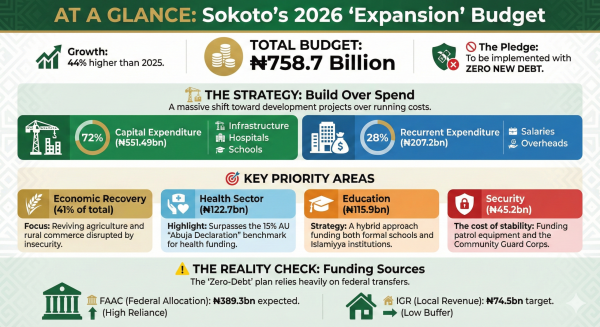
When Governor Ahmed Aliyu of Sokoto state presented the 2026 appropriation bill to the State House of Assembly on December 17, 2025, the headline figure was the unprecedented ₦758.7 billion total. But for close watchers of sub-national economies in Nigeria, the real story wasn’t the size of the envelope – it was the governor’s audacious claim that this massive expansion would be funded without a single kobo of new debt.

Christened the “Budget of Socio-Economic Expansion,” the proposal represents a 44 per cent increase from 2025. It is a bold statement of intent for a state grappling with insecurity and development gaps. However, a deep dive into the allocations reveals a budget that is as high-risk as it is high-reward, relying heavily on federal largesse to fund a massive infrastructure drive.

Here is an analysis of what the 2026 budget allocations really mean for the people of Sokoto.

The 72:28 split: A rare development bias

In a country where recurrent expenditure – salaries, overheads, and running costs – often swallows the bulk of state resources, Sokoto’s 2026 plan is an outlier. The administration has allocated ₦551.49 billion (72%) for Capital Expenditure, leaving Recurrent Expenditure at ₦207.2 billion (28%).

What this means: This aggressive ratio signals that the government intends to turn the state into a construction site. It prioritizes tangible assets – roads, bridges, and hospitals—over the machinery of government. However, such a high capital projection requires immense implementation capacity. The administration cites a 65 per cent performance rate in 2025 as proof of competence, but scaling that up to manage over half a trillion naira in projects will be the ultimate test of its bureaucracy.

Sectoral winners: Agriculture as security?

The Economic Sector takes the lion’s share with 41 per cent of the total budget. While this covers commerce and industry, the strategic focus is clearly on Agriculture and Water Resources.

The Analysis: In Sokoto, agriculture is not just economics; it is security. Years of banditry have displaced farmers and disrupted rural food systems. By pouring funds into this sector, the government appears to be banking on a “stabilization through cultivation” strategy – betting that reviving the rural economy will reduce the vulnerability of youth to criminal recruitment. The success of this allocation, however, is entirely dependent on the security situation allowing farmers to actually access the funded fields.

Breaking the Abuja declaration jinx

Perhaps the most commendable aspect of the budget is the Social Sector (37%), specifically the health allocation.

With ₦122.7 billion allocated to Health, Sokoto has surpassed the 15 per cent benchmark set by the African Union’s 2001 Abuja Declaration – a target most Nigerian states (and the Federal Government) routinely miss.
Sokoto
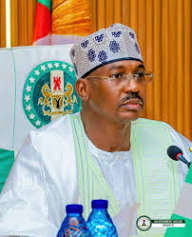
Sokoto State Governor

The Impact: If released and utilized, this funding could overhaul the state’s grim health indices. The plan to upgrade specialist hospitals in local government areas suggests a move to decentralize care, reducing the pressure on the state capital. Similarly, the ₦115.9 billion for Education – integrating Islamiyya schools with formal education – shows a policy nuance designed to increase acceptance and literacy in a culturally conservative environment.

The revenue elephant in the room

The “Zero-Debt” promise sounds fiscally responsible, but the revenue breakdown exposes a significant vulnerability.

  • FAAC Expectation: ₦389.3 billion
  • IGR Expectation: ₦74.5 billion

The budget is heavily anchored on Federal Accounts Allocation Committee (FAAC) transfers. While Internally Generated Revenue (IGR) is projected to grow to ₦74.5 billion, it remains a small fraction of the state’s needs.

The Risk: Sokoto is effectively tying its development pace to the volatility of the crude oil market and the efficiency of the NNPCL. A dip in national revenue could leave the state with a budget deficit that cannot be filled without breaking the “no borrowing” pledge. The administration is walking a tightrope: it needs federal inflows to remain perfect to deliver its ambitious projects without seeking loans.

Verdict

The 2026 budget is a document of high ambition. By prioritizing capital projects and social investments, Governor Aliyu has correctly identified the state’s pain points. However, the refusal to borrow, while politically popular, removes a safety net.

For the next 12 months, the success of the “Budget of Socio-Economic Expansion” will depend less on the ₦758.7 billion figure and more on the consistency of federal allocations and the government’s discipline in plugging revenue leakages at home.

Ahmed Aliyu Analysis Budget Nigeria Sokoto
Share. Facebook Twitter Pinterest LinkedIn WhatsApp Reddit Tumblr Email
John Asishana

Related Posts

Nigeria leads Africa on global largest goat meat producing countries

January 29, 2026

CBN, British international investment deepen talks on banking stability, long-term capital

January 28, 2026

Türkiye targets $5bn trade volume with Nigeria — Erdogan

January 27, 2026

Leave A Reply Cancel Reply

[VIEWPOINT] Why FG Should halt the persecution of Ozekhome, By Echika Ejido

January 30, 2026

Taraba: NAPTIP intercepts trafficker with 10 children

January 30, 2026

FG empowers 40 cooperatives with farm inputs in Yobe

January 30, 2026

PenCom launches online platform

January 30, 2026
About Us
About Us

ASHENEWS (AsheNewsDaily.com), published by PenPlus Online Media Publishers, is an independent online newspaper. We report development news, especially on Agriculture, Science, Health and Environment as they affect the under-reported rural and urban poor.

We also conduct investigations, especially in the areas of ASHE, as well as other general interests, including corruption, human rights, illicit financial flows, and politics.

Contact Info:
  • 1st floor, Dogon Daji House, No. 5, Maiduguri Road, Sokoto
  • +234(0)7031140009
  • ashenewsdaily@gmail.com
Facebook Twitter Instagram Pinterest
© 2026 All Rights Reserved. ASHENEWS Daily Designed & Managed By DeedsTech

Type above and press Enter to search. Press Esc to cancel.