


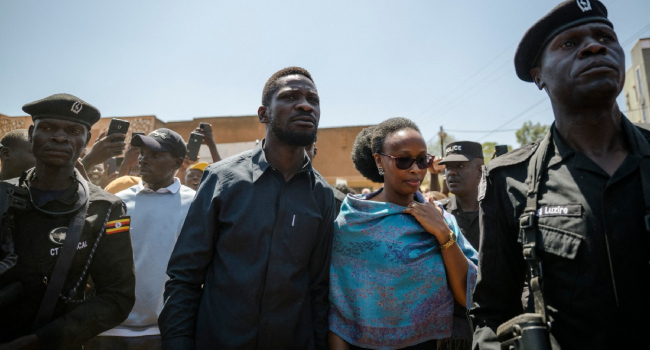
Ugandan opposition leader Bobi Wine said on Saturday that he was in hiding after escaping what he described as a police and military raid on his home, as the country awaited the outcome of a tense election conducted under an internet blackout.
Earlier, Wine’s party claimed he had been forcibly taken away in an army helicopter on Friday, a day after elections marred by reports of violence and intimidation. However, Wine later said he managed to evade arrest.
“I want to confirm that I managed to escape from them. Currently, I am not at home, although my wife and other family members remain under house arrest,” Wine wrote on X. “I know that these criminals are looking for me everywhere, and I am trying my best to keep safe.”
President Yoweri Museveni, 81, appeared set to secure victory and extend his nearly 40-year rule. With more than 90 per cent of votes counted, the Electoral Commission said Museveni was leading with 71.9 per cent, while Wine, 43, had 24.5 per cent.
ALSO READ Uganda: 81-year-old Museveni wins seventh term amid violence claims, internet shutdown
There were conflicting reports over Wine’s whereabouts following claims that security forces raided his residence on Friday night. Police denied arresting him, saying they had merely “controlled access” to areas deemed security hotspots to prevent unrest.
“We have not necessarily denied people accessing him, but we cannot tolerate instances where people use his residence to gather and incite violence,” police spokesman Kituuma Rusoke said.
AFP journalists reported a heavy security presence in Kampala, with police and soldiers forcing people off the streets to deter protests similar to those recently seen in neighbouring Kenya and Tanzania. Residents near Wine’s home described drones, helicopters and an overwhelming security presence, prompting many to flee the area.
“Many people have left. We have a lot of fear,” said Prince Jerard, a stall owner in the neighbourhood.
Wine, whose real name is Robert Kyagulanyi, has emerged as Museveni’s main challenger in recent years, branding himself the “ghetto president” after his upbringing in Kampala’s slums. He accused the government of massive ballot stuffing and targeting opposition figures during the internet shutdown imposed ahead of the polls.
African election observers said they found no evidence of ballot stuffing but condemned reports of intimidation, arrests and abductions involving opposition members and civil society. Former Nigerian President Goodluck Jonathan, leading observer missions from the African Union, COMESA and IGAD, said such actions had “instilled fear and eroded public trust in the electoral process.”
Jonathan noted that the internet shutdown disrupted effective observation and heightened suspicion, although voting on election day was generally peaceful.
Analysts had widely described the election as a formality, citing Museveni’s firm grip on state institutions and security forces since taking power in 1986. Another prominent opposition figure, Kizza Besigye, remains on trial for treason after being abducted in Kenya in 2024 and returned to Uganda.
There were also conflicting accounts of election-related violence. An opposition lawmaker alleged that security forces killed 10 campaign agents in central Uganda, while police said an unspecified number of people were neutralised during an attempted attack on a tally centre and police station.
AFP
