


The Revenue Mobilisation Allocation and Fiscal Commission (RMAFC) has completed a comprehensive review of Nigeria’s Revenue Allocation Formula and finalised work on the remuneration of judicial office holders, while the review for executive and legislative office holders has reached an advanced stage.
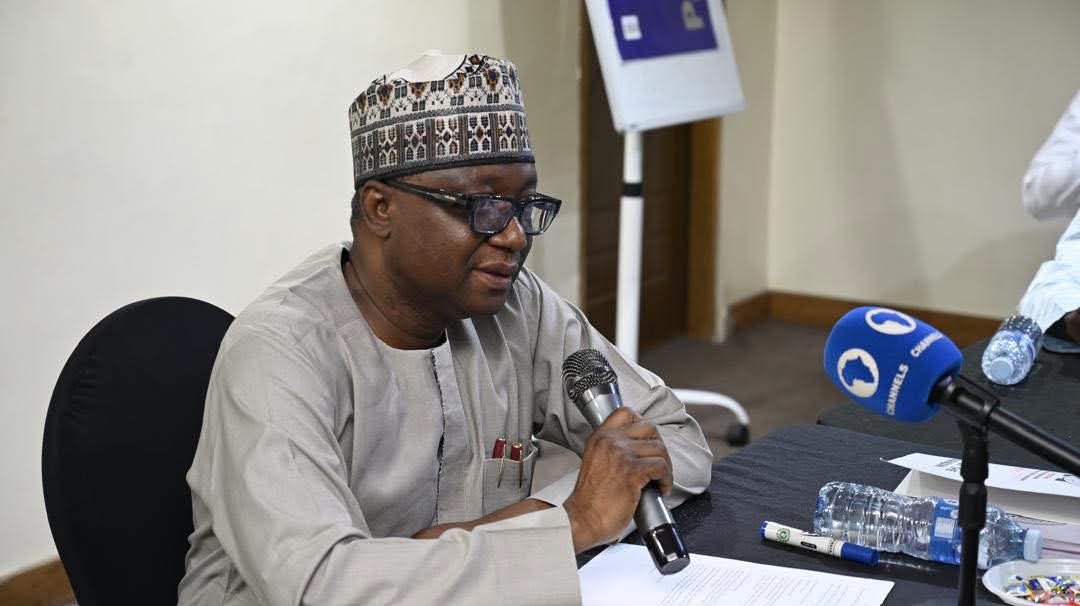
RMAFC Chairman Dr. Mohammed Bello Shehu, OFR, disclosed this on Saturday during an interactive session with members of the Nigerian Guild of Editors (NGE) in Lagos. He presented an overview of the Commission’s achievements and institutional progress from 2023 to date.
Shehu said the period under review was marked by significant fiscal reforms. The Commission strengthened its constitutional mandate covering revenue monitoring, derivation verification, fiscal coordination, and advisory functions on remuneration and revenue allocation.
According to him, RMAFC focused on improving data integrity, enhancing inter-agency collaboration, and ensuring equitable distribution of national revenue across the federal, state, and local government tiers.
The Chairman explained that the Commission intensified monitoring of oil and gas production data to ensure accurate application of the 13 percent derivation principle. Through verification exercises, geospatial mapping, and inter-agency collaboration, it resolved several long-standing oil well attribution issues. These included the reallocation of 17 oil wells from Imo State to Rivers State in line with a Supreme Court judgment.
Similar interventions were carried out in Cross River, Akwa Ibom, Imo, and Anambra States. Improved gas production reporting also enabled Enugu and Kogi States to benefit from derivation revenues.
Shehu noted that RMAFC had strengthened collaboration with key institutions, including the Nigerian Upstream Petroleum Regulatory Commission (NUPRC), the Nigerian National Petroleum Company Limited (NNPCL), the Nigerian Midstream and Downstream Petroleum Regulatory Authority (NMDPRA), the National Boundary Commission, and the Office of the Surveyor-General of the Federation. These partnerships aimed to improve revenue monitoring and compliance.
He also disclosed ongoing engagement with the Ministry of Defence to tackle crude oil theft, pipeline vandalism, and production losses, which he described as major threats to national revenue.
Beyond the petroleum sector, the Commission is exploring new revenue opportunities through partnerships with the Federal Airports Authority of Nigeria (FAAN) and the National Space Research and Development Agency (NASRDA). This includes the use of satellite and geospatial technologies to identify additional revenue sources.
On remuneration, Shehu confirmed that the review for judicial office holders had been completed, culminating in the enactment of the Judicial Office Holders (Salaries and Allowances) Act, 2025. The review of remuneration for executive and legislative office holders is at an advanced stage, with an executive bill on the Political and Public Office Holders (Salaries and Allowances) Act, 2026 expected to be transmitted to the National Assembly.
He stressed that remuneration reforms must be matched with accountability and performance, adding that improved pay should translate into improved service delivery.
Regarding the Revenue Allocation Formula review, Shehu described it as one of the Commission’s most significant assignments. It was undertaken through extensive consultations with all tiers of government, technical stakeholders, and nationwide engagements. The exercise involved analysis of fiscal responsibilities, revenue trends, and comparative federal systems, resulting in a harmonised report and legislative proposals now ready for transmission to the appropriate authorities.
The disclosures come as Nigeria continues efforts to update its longstanding revenue-sharing framework and align public officers’ compensation with current economic realities and performance expectations.
