



Northern Nigeria is home to some of Africa’s most promising yet underdeveloped poultry investment opportunities. Despite possessing vast agricultural land, abundant feed resources, a rapidly growing population and increasing demand for affordable animal protein, the region remains heavily dependent on external sources of critical poultry inputs including breeder stock, day-old chicks, vaccines, veterinary products, equipment and technical services.
This dependence has created significant inefficiencies across the poultry value chain while simultaneously opening up attractive opportunities for investors, development finance institutions and development partners.
With Nigeria’s poultry industry generating more than US$3 billion annually and demand projected to increase significantly over the next decade, Northern Nigeria is uniquely positioned to emerge as West Africa’s leading poultry production and distribution hub. The challenge is no longer whether the opportunity exists, but whether stakeholders can mobilize the investment required to unlock it.
The Opportunity Hidden in Plain Sight
Few sectors in Northern Nigeria combine the economic, social and developmental impact of poultry.
Across Kaduna, Kano, Plateau, Niger, Nasarawa, Adamawa, Bauchi, Jigawa and several other states, poultry production has become an increasingly important source of employment, income generation and food security. Eggs and poultry meat remain among the most affordable animal protein sources available to millions of households.
Yet, beneath the growth story lies a fundamental paradox.
While Northern Nigeria produces much of the maize and soybean that are required for poultry feed, many producers continue to rely on day-old chicks, breeder stock, vaccines and specialized inputs sourced from outside the region. Consequently, poultry businesses face higher production costs, supply disruptions and reduced competitiveness.
For investors, however, these weaknesses represent opportunities.
Every missing link within the value chain represents a potential investment opportunity that is capable of generating attractive returns while strengthening the broader poultry ecosystem.
Understanding the Scale of the Market
Nigeria currently operates one of Africa’s largest poultry industries. Industry estimates indicate annual production exceeding 15 billion eggs, approximately 1.5 million tonnes of poultry meat and over 200 million day-old chicks.
The industry supports millions of direct and indirect jobs while contributing significantly to national agricultural output.
What makes Northern Nigeria particularly attractive is its demographic advantage.
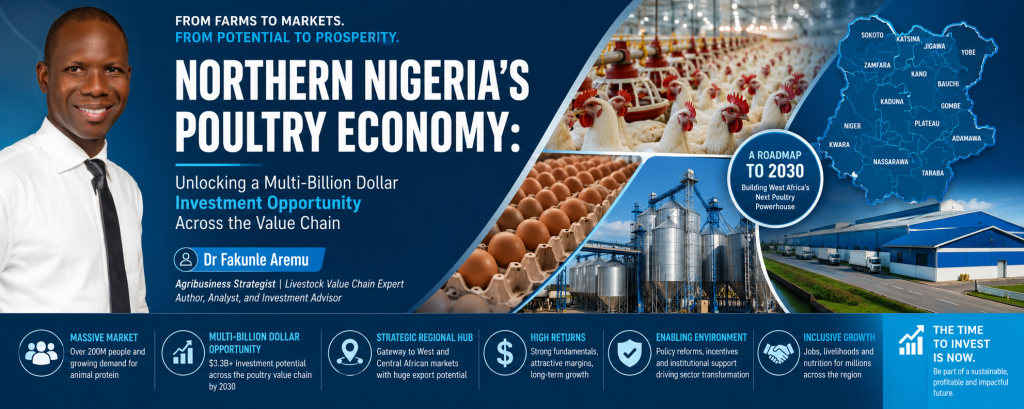
The region accounts for a substantial proportion of Nigeria’s population and continues to experience rapid population growth. Cities such as Kano, Kaduna, Abuja, Jos, Bauchi and Minna are expanding rapidly. These are creating increasing demand for eggs, chicken meat and processed poultry products.
Urbanization, rising incomes and changing dietary preferences are expected to further increase poultry consumption over the coming decade.
Conservative projections suggest that Northern Nigeria’s poultry economy could exceed US$5 billion annually by 2030 if strategic investments are deployed across critical segments of the value chain.
The Geography of Opportunity
Not all states offer identical opportunities.
Kaduna State remains the region’s most advanced poultry investment destination due to its integrated poultry infrastructure, feed manufacturing capacity and strategic location.
Kano offers access to one of West Africa’s largest consumer markets and serves as a major commercial hub for poultry trade.
Plateau State provides unique climatic advantages that reduce heat stress and improve poultry productivity.
Niger State’s grain production capacity positions it as a future feed manufacturing hub, while Nasarawa benefits from proximity to Abuja’s rapidly growing consumer market.
Adamawa and Bauchi also present strong opportunities for integrated poultry investments due to their land availability and expanding commercial agriculture sectors.
For investors seeking long-term growth, emerging opportunities are also beginning to appear in Jigawa, Katsina, Kebbi, Taraba and Yobe States.
Breeder Farms: The Missing Foundation
Perhaps the most significant weakness within Northern Nigeria’s poultry economy lies in breeder operations.
Breeder farms occupy the top of the poultry production pyramid by producing fertile eggs used by hatcheries to generate commercial day-old chicks.
Without sufficient breeder capacity, every downstream segment of the poultry industry becomes vulnerable.
At present, much of Northern Nigeria remains dependent on breeder infrastructure located elsewhere. This creates supply bottlenecks, increases transportation costs and exposes producers to operational risks.
The region requires significant investments in grandparent stock farms, parent stock operations and breeding facilities capable of supporting future demand.
Investors who enter this segment early are likely to occupy strategic positions within the poultry ecosystem for decades to come.
Hatcheries and Day-Old Chick Production
The shortage of quality day-old chicks remains one of the most frequently cited constraints affecting poultry farmers across Northern Nigeria.
Many producers continue to source chicks from distant hatcheries, increasing transportation costs and mortality risks while reducing profitability.
As poultry demand continues to expand, the need for additional hatchery capacity becomes increasingly urgent.
Regional hatchery hubs located in Kaduna, Kano, Jos, Bauchi and Nasarawa could significantly strengthen poultry production systems across multiple states.
Few segments of the poultry industry offer the combination of recurring demand, scalability and strategic importance found within hatchery operations.
Feed Production: The Real Profit Driver
Feed represents the largest cost component within poultry production, often accounting for between 60 and 75 percent of total operating expenses.
Fortunately, Northern Nigeria already possesses many of the resources required to become a regional feed manufacturing powerhouse.
The region produces substantial quantities of maize, soybean, sorghum and groundnut. However, inadequate storage infrastructure, weak aggregation systems and limited processing capacity continue to increase feed costs.
Opportunities exist in:
Feed mills.
Grain aggregation centers.
Soybean crushing plants.
Storage infrastructure.
Feed ingredient manufacturing.
The future competitiveness of Northern Nigeria’s poultry sector will depend largely on its ability to develop integrated feed production systems.
Animal Health and Veterinary Services
Disease outbreaks remain among the most significant risks facing poultry investments.
Northern Nigeria continues to depend heavily on veterinary products and vaccines distributed through supply chains originating outside the region.
Weak cold-chain systems, limited diagnostic capacity and inadequate veterinary infrastructure increase vulnerability to disease outbreaks and reduce investor confidence.
Significant opportunities exist in:
Veterinary pharmaceutical distribution.
Poultry diagnostic laboratories.
Vaccine storage facilities.
Digital disease surveillance systems.
Mobile veterinary services.
As poultry populations continue to expand, animal health infrastructure will become increasingly important.
Processing: The Untapped Goldmine
One of the most underdeveloped segments of Northern Nigeria’s poultry economy is processing.
Much of the poultry industry remains focused on primary production, while value addition opportunities in slaughtering, packaging, cold storage and branded products remain largely underexploited.
As urban consumers increasingly demand processed and packaged poultry products, opportunities in poultry processing continue to expand.
Investments in processing facilities offer several advantages:
Higher profit margins.
Product differentiation.
Improved food safety.
Expanded market access.
Export readiness.
The future of the poultry industry will increasingly depend on value addition rather than production volume alone.
Poultry and Food Security
Beyond its commercial importance, poultry plays a critical role in food security and nutrition.
Eggs and poultry meat provide affordable sources of high-quality protein, making them essential components of efforts to combat malnutrition and improve dietary diversity.
Expanding poultry production can contribute directly to:
Improved child nutrition.
Reduced protein deficiency.
Increased food availability.
Women’s economic empowerment.
Youth employment.
For governments and development partners, investments in poultry generate benefits that extend far beyond agricultural production.
The Financing Challenge
Access to finance remains one of the greatest constraints affecting poultry development.
The sector requires substantial investments in breeder farms, hatcheries, feed mills, processing facilities, logistics infrastructure and working capital.
However, many producers struggle to access affordable long-term financing.
Conservative estimates suggest that Northern Nigeria’s poultry value chain may require over US$1 billion in investments over the next decade to fully realize its potential.
This financing gap creates opportunities for:
Commercial banks.
Development finance institutions.
Impact investors.
Private equity firms.
Agricultural investment funds.
Financial innovation will be essential for unlocking future industry growth.
Six Strategic Investment Opportunities
The most bankable opportunities currently available include:
Northern Poultry Breeding Complexes.
Regional Hatchery Networks.
Integrated Feed Manufacturing Hubs.
Poultry Processing and Cold Chain Facilities.
Poultry Industrial Parks.
Poultry Finance and Insurance Platforms.
These investments address critical bottlenecks while creating strong commercial and developmental returns.
Looking Toward 2030
The outlook for Northern Nigeria’s poultry economy remains highly positive.
Population growth, urbanization, rising incomes, livestock sector reforms and increasing private sector participation are expected to drive continued expansion.
By 2030, Northern Nigeria has the potential to become:
West Africa’s leading poultry production hub.
A major supplier of day-old chicks.
A regional feed manufacturing center.
An exporter of processed poultry products.
A destination for livestock investment and innovation.
Realizing this vision will require coordinated action from governments, investors, financial institutions and development partners.
Conclusion
Northern Nigeria’s poultry economy represents one of Africa’s most compelling agribusiness opportunities.
The region possesses abundant feed resources, growing consumer markets, strategic trade corridors and increasing policy support. Yet significant gaps remain across breeder operations, hatcheries, feed manufacturing, veterinary services, processing and logistics.
For investors, these gaps are not weaknesses. They are opportunities.
The greatest value will not necessarily come from producing more birds. It will come from building the systems that enable poultry production to thrive: breeder farms, hatcheries, feed mills, veterinary infrastructure, processing facilities, logistics networks and innovative financing platforms.
Those who recognize this opportunity today will be positioned at the forefront of one of Africa’s most important agribusiness growth stories over the next decade.
Northern Nigeria’s poultry economy is no longer merely an agricultural subsector. It is an emerging investment frontier with the potential to transform food systems, create jobs, strengthen nutrition and drive inclusive economic growth across the region.
Dr. Fakunle Aremu is Senior Management Consultant | Trade, Policy & Development Advisor | African Economic Transformation Expert. He can be reached via fakunle2014@gmail.com +2348063284833
