


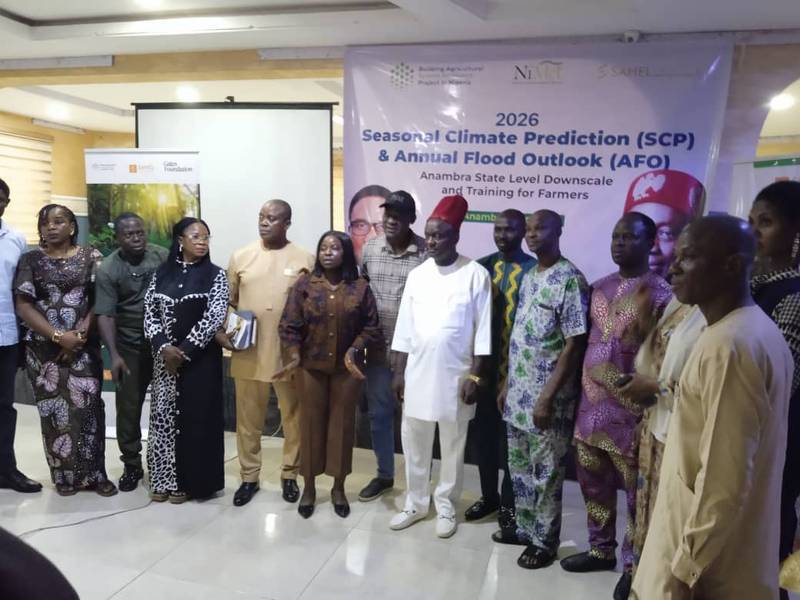
The Federal Government has urged farmers to leverage the 2026 Seasonal Climate Prediction to boost productivity and reduce risks linked to climate variability, especially in vulnerable agricultural communities across Nigeria.
The Minister of Agriculture and Food Security, Sen. Abubakar Kyari, made the call on Monday during a seminar organised for farmers in Anambra by the Nigerian Meteorological Agency (NiMet) and its partners.
The seminar was held in collaboration with the Nigeria Hydrological Services Agency and other partners to strengthen agricultural resilience among farmers in the state.
Partners included the Bill and Melinda Gates Foundation and Sahel Consulting Agriculture and Nutrition Limited, supporting efforts to improve climate adaptation, risk management and sustainable agricultural practices.
The event focused on sensitising farmers to the 2026 Seasonal Climate Prediction and the Annual Flood Outlook, highlighting risks, opportunities and preparedness measures needed for effective climate-smart agricultural planning and action.
Kyari, represented by the State Director, Chief Arthur Mbuba, said the training was designed to enlighten farmers on climate forecasts, their implications for agriculture, and practical steps to improve yields and resilience.
He commended the organisers for selecting Anambra as one of the six participating states, describing the initiative as timely and essential for equipping farmers with critical information on climate variability and climate-smart agricultural practices.
The Director-General of NiMet, Prof. Charles Anosike, said the seasonal prediction should serve as an early warning tool for farmers, noting that rainfall onset in Anambra is expected from March 23.
He added that the end of the growing season is projected between November 27 and December 4, with several local government areas expected to experience high rainfall, flooding and temperature variations.
He identified high flood-risk areas as Anambra East, Anambra West, Ayamelum, Onitsha North, Onitsha South, Ogbaru and Ekwusigo, while other councils fall within moderate-risk zones across the state.
Officials from agricultural and emergency agencies urged increased awareness, early planting, adoption of insurance, proper drainage maintenance and timely evacuation from vulnerable communities.
They reaffirmed their commitment to proactive disaster management and improved agronomic practices.
