


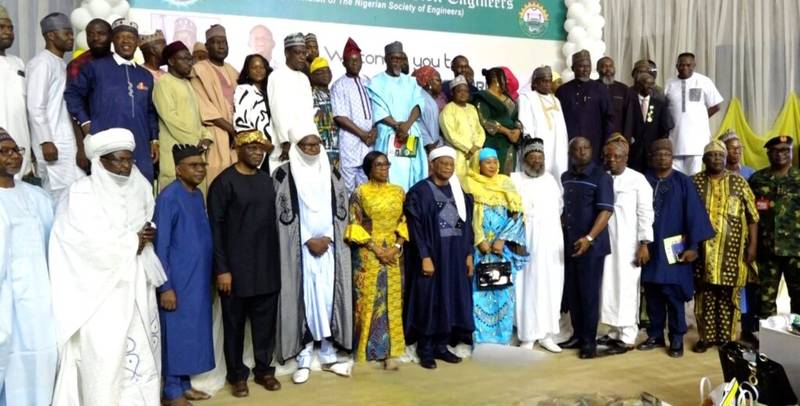
The Nigerian Institution of Civil Engineers (NICE) has called for sweeping reforms in urban mass transport, warning that rapid urbanisation is outpacing infrastructure and policy delivery.
The call was made on Sunday at the 6th U.G. Jibrin Distinguished Annual Public Lecture in Abuja, themed “Urban Mass Transportation: An Urgent Agenda.”
Guest speaker, Mr. Nebolisa Emordi, said Nigeria’s urban population has exceeded 100 million, with nearly 70 per cent projected to live in cities by 2050.
He said the surge demands urgent and deliberate action to modernise transport through strategic planning, regulation, and technology-driven solutions.
Emordi noted that the system is heavily road-dependent, accounting for about 80 per cent of passenger and freight movement, yet remains poorly regulated and fragmented.
“So, the urban mass transportation system must urgently evolve through deliberate planning, prioritisation, analysis, and enforcement of regulations,” he said.
He added that it requires “strategic, technology-driven transformation and collaborative indigenous efforts” to tackle congestion and meet national transport policy goals.
“It will also promote public-private partnerships and create sustainable infrastructure such as bus lanes, transit stations, and CNG-powered buses.
“Classically, urban mass transportation adopts integrated multimodal systems incorporating road, rail, air, and water modes,” Emordi said.
He observed that informal transport, including motorcycles and private cars, accounts for over half of urban transit, exposing gaps in formal infrastructure.
Emordi advocated city-specific transport master plans backed by data, private sector participation, and smart technologies like GPS tracking and unified ticketing.
NICE Chairman, Mr. Tokunbo Ajanaku, said the lecture honoured Umar Jibrin and reflected a pressing national need for efficient urban mobility.
“Everything in Nigeria depends on efficient urban transportation, yet challenges have not been clearly defined.
“As engineers, we must advance positions that crystallise into policies and projects driving efficient urban transport infrastructure,” Ajanaku added.
President of the Nigerian Society of Engineers, Mr. Ali Rabiu, said traffic congestion wastes productive hours and hampers economic growth.
Represented by his deputy, Mr. Valery Agberagba, he said: “Urban mass transit is a call to action that must receive serious national attention.
“We have started many initiatives but regressed. This is not acceptable.”
The Emir of Nasarawa, Ibrahim Jibrin, cited policy inconsistency as a major setback to transport development.
He urged government continuity and called on engineers to advocate consistent policies to ensure projects are completed and sustained.
Umar Jibrin, a former Executive Secretary of the Federal Capital Development Authority, said Abuja’s master plan already provides a solid transport framework but suffers from weak implementation.
“The only missing link is implementing the master plan, including completing road networks to support intra- and inter-district transport,” he said.
