


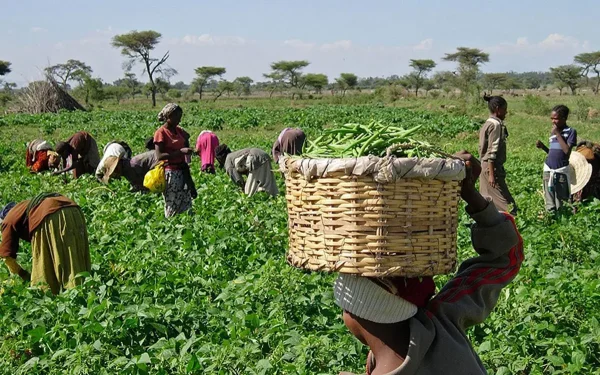
The Bridge Connect Africa Initiative (BCAI) on Thursday empowered 16 women in Kano State on Climate-Smart Agriculture (CSA) adaptation to promote economic growth and household food security amid climate challenges.
The two-day Training of Trainers (ToT) was organized under Phase II of the Women Against Violence Empowered through Sustainability (WAVES) Project and supported by the French Embassy Fund for Civil Society Organizations (FEF-CSOs).
Speaking at the event, the WAVES Project Lead, Mr Nathan Bako, said the initiative was designed to strengthen women’s knowledge and capacity to disseminate CSA practices within their communities and scale up the adoption of resilient food production systems.
Bako said participants had already mastered practical skills in bed and sack cultivation of cucumber and okra and had successfully replicated the practices.
“This advanced workshop was aimed at equipping a core group of women with facilitation skills, simplified technical knowledge and the confidence to become community CSA champions.
“They will be empowered to conduct step-down trainings, disseminating adaptable, low-resource CSA techniques to wider groups of women in their communities, thereby scaling up home-based food production and climate resilience,” he said.
Also speaking, the Programmes Associate of BCAI and Project Programme Manager, Ms Ruqayya Abdulhadi, said the 16 women were drawn from eight clusters across the state.
She explained that the participants were selected from an earlier group of 50 women who benefited from the project’s foundational training.
“The participants are expected to return to their communities and train at least 20 other women each. This means the workshop is expected to reach about 200 women in total,” Abdulhadi said.
She expressed confidence that the women would make significant impact in their communities by promoting sustainable agricultural practices and helping to reduce gender-based violence.
One of the facilitators, Fatima Muftau, who spoke on soil and nutrient management, water management, crop management, as well as monitoring and evaluation, encouraged the participants to excel and apply the knowledge gained.
Speaking on behalf of the participants, Ms Zainab Magaji-Suleiman from Tarauni Local Government Area commended BCAI for the initiative, describing it as timely and impactful.
She said the training exposed her to climate-smart agriculture practices she previously lacked knowledge of and pledged to step down the training in her community.
“The training has helped me understand how to improve my livelihood through climate-smart agriculture. I can now produce homemade fertilizer.
“I have successfully planted okra and cucumber, which my family consumes. I intend to plant more okra, cucumber and red bell pepper in my next farming cycle to expand my business,” she said.
