


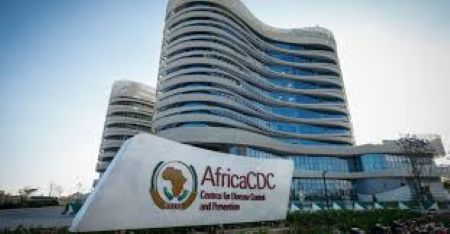
The Africa Centres for Disease Control and Prevention (Africa CDC) has urged African countries to strengthen community-based surveillance, expand vaccination coverage, and deepen cross-border collaboration to curb the spread of infectious disease outbreaks across the continent.
Prof. Yap Boum, Incident Manager for Health Emergencies at the Africa CDC, made the call on Friday during the agency’s weekly news conference reviewing the epidemiological situation of Mpox, cholera, Ebola, Rift Valley fever, malaria, and other priority diseases in Africa.
Boum said that although significant progress had been recorded, particularly with the Ebola outbreak in the Democratic Republic of Congo (DRC) nearing its 42-day countdown to being declared over, continued vigilance was essential.
“We are in the countdown phase for Ebola in Bulape, but this does not mean we are out of the outbreak. We must strengthen monitoring, surveillance, and community engagement to sustain progress,” he said.
He disclosed that more than 37,000 people—including healthcare workers and children—had been vaccinated against Ebola. He added that Africa CDC and its partners were supporting preventive vaccination in other provinces and neighbouring countries to bolster preparedness.
On Mpox, Boum reported an 80 per cent decline in cases from the peak of the outbreak, with 13 countries having conducted vaccination campaigns that reached more than 1.5 million people.
However, he expressed concern over rising cases in Kenya, Liberia, and Ghana, where active transmission continues.
“We are not resting until all member states reach acceptable thresholds for transition to national surveillance. We are supporting Kenya with 20,000 additional vaccine doses and helping to strengthen community-level response and communication,” Boum said.
He commended Namibia’s swift and coordinated response, which limited Mpox transmission to only two confirmed cases, describing it as proof that “rapid action and strong leadership can stop transmission at the source.”
On cholera, Boum described it as Africa’s “most challenging disease,” revealing that 297,394 cases and 6,084 deaths had been reported across 23 member states so far in 2025.
He cautioned that the rainy season could exacerbate transmission in high-burden countries such as Angola, Burundi, Sudan, and South Sudan, unless urgent multisectoral interventions—particularly in water, sanitation, and hygiene (WASH)—were implemented.
“We must move beyond emergency response and invest in infrastructure that guarantees access to clean water and sanitation. Cholera is a disease of inequity, and stopping it requires a whole-of-government and whole-of-society approach,” he said.
Boum reiterated Africa CDC’s commitment to supporting National Public Health Institutes (NPHIs) to strengthen community-based surveillance and improve early outbreak detection and response.
“Our goal is to build resilient systems that prevent future outbreaks rather than react to them. Strong community engagement, rapid response, and cross-border coordination remain our best tools,” he emphasized.
He also noted ongoing efforts to boost malaria prevention through the distribution of insecticide-treated nets and environmental sanitation, especially in Southern Africa, where seasonal increases in malaria cases have been observed.
Meanwhile, Dr Kyeng Mercy, speaking on behalf of Africa CDC’s Surveillance and Disease Intelligence Unit, said the agency had launched a continental data architecture and health information exchange policy to ensure privacy, data protection, and harmonised disease reporting across member states.
The Africa CDC, through its Incident Management Support Team (IMST), coordinates outbreak preparedness and response across the continent. Working closely with the World Health Organisation (WHO), national public health institutes, and regional partners, the IMST provides technical guidance, emergency logistics, and training to strengthen Africa’s capacity to detect, prevent, and control infectious disease outbreaks.
