


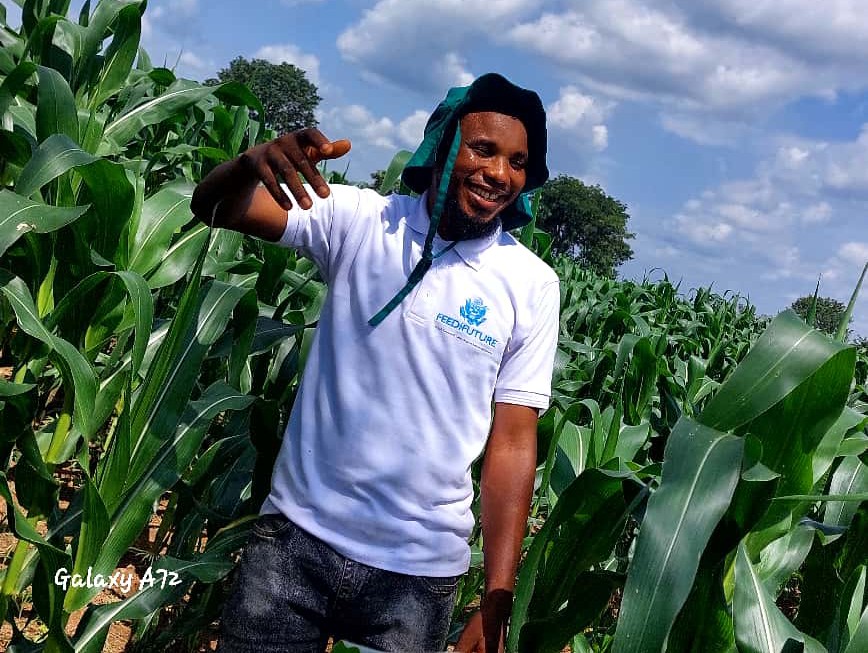
Achieving the global goal of promoting sustainable agriculture requires the deliberate efforts of young researchers to drive innovation that connects science with real-world farming. In agriculture, the sustainable use of resources depends on striking a balance between environmental, economic, and agronomic needs. One young Nigerian researcher, Kehinde Afeez Ojeniyi, has taken up this mission to ensure crop production thrives without undermining the soil’s healthy ecosystems.
From Nigeria to Morocco to the United States, Kehinde’s academic and professional journey spans three continents and integrates a unique blend of disciplines. He earned a bachelor’s degree in Soil/Crop Science from Usmanu Danfodiyo University in Nigeria and a master’s degree in Fertilizer Science and Technology at the University of Mohammed VI Polytechnic in Morocco. He is currently pursuing a PhD in Agroecology and Sustainable Agriculture at Southern Illinois University Carbondale. Before starting his doctorate, Kehinde gained valuable industry experience with OCP Africa, one of the continent’s leading fertilizer companies.
A Growing Record of Impact
His curiosity about how blended NPK fertilizer compared with straight fertilizer sources (urea, single superphosphate, and muriate of potash) in improving nutrient-use efficiency inspired his research on optimizing split-fertilizer applications to boost maize yield in Nigeria’s Middle Belt. While blended NPK remains the backbone of crop production across the country, Kehinde argues that improving access to straight fertilizers could create a better balance between economic return, environmental safety, and agronomic efficiency.
As an agronomist with OCP Africa, he managed more than 1,000 hectares of farmland and supervised over 10 farm supervisors on best management practices to increase yields of maize, rice, and soybeans across Benue and Bauchi States. He also inspected numerous fertilizer validation trials on tomato, cocoa, rice, and soybean in different regions of Nigeria. To support smallholder farmers, he developed Excel-based models for fertilizer recommendations, reducing their dependence on soil scientists for basic advisory services. These experiences strengthened his ability to connect high-level research with practical farming.
At SIU, under the mentorship of a multidisciplinary committee chaired by Dr. Jon Schoonover, Kehinde is studying nitrogen and phosphorus attenuation from an innovative Water and Sediment Control Basin (WASCoB). The system is designed to control gully erosion while trapping sediments and nutrients in agricultural runoff. His research, funded by the Illinois Nutrient Research and Education Council (INREC) as part of the Illinois Nutrient Loss Reduction Strategy (INLRS), uses advanced tools such as automated water samplers and data loggers to generate field-based data on the nutrient-trapping efficiency of WASCoBs in Southern Illinois.
Kehinde’s work has already attracted recognition. In 2023, he became only the fourth Nigerian to win the African Plant Nutrition Institute Scholar Award, which is given annually to 10 outstanding scholars across Africa. In 2022, he won the Farm of the Future Innovation Contest organized by the Innovation and Entrepreneurship Lab (ie_lab) at the University of Mohammed VI Polytechnic. He is also a recipient of the Ibn Roch Foundation for Science and Innovation Scholarship and the UM6P Scholarship under Social Condition (BUCS) in 2021.
He has presented his research at several prestigious international conferences, including the 9th International Symposium on Soil Organic Matter in Morocco (2024); the Universities Council on Water Resources/National Institute for Water Resources Conference in Minneapolis (2025); the Illinois Nutrient Reduction Education Council Investment Insight, University of Illinois Urbana-Champaign (2025); and the Nitrogen Shapes Agriculture’s Sustainable Future Workshop at Purdue University (September 19, 2025). He is also scheduled to give a talk at the South Dakota Student Water Conference on October 14, 2025.
Looking ahead, Kehinde envisions a career as a soil conservationist and nutrient management specialist. His ultimate goal is to ensure that best management practices become standard tools for safeguarding global food security.
His journey shows how a young researcher, driven by both science and service, can help bridge the gap between agricultural productivity and environmental sustainability. Kehinde Afeez Ojeniyi represents a new generation of researchers advancing sustainable food production in Nigeria and beyond.
