



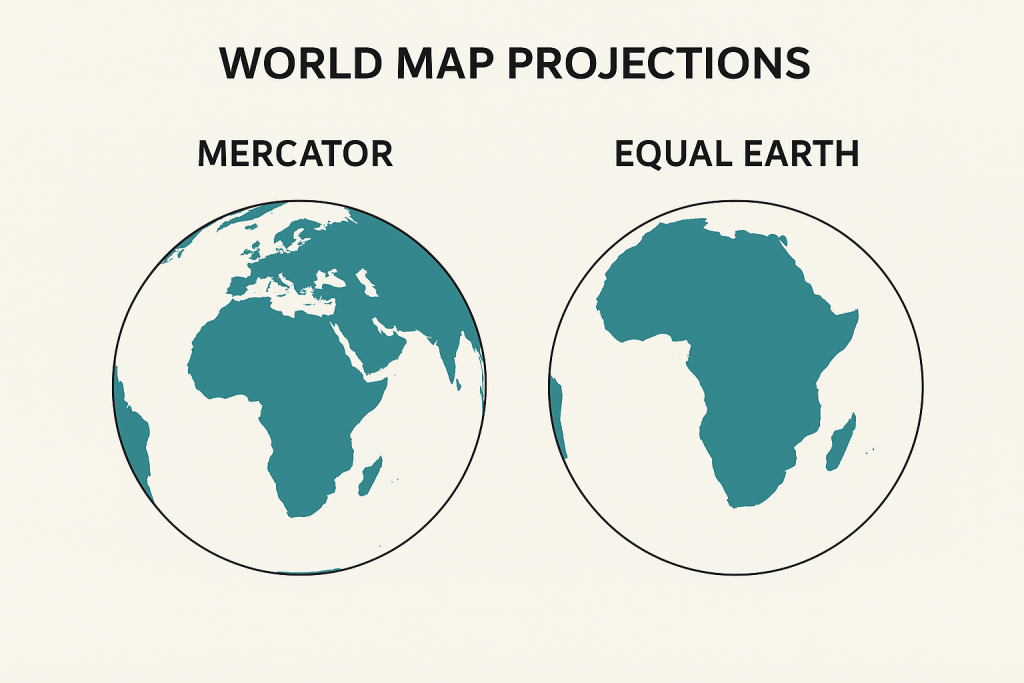
The African Union (AU) has formally endorsed the “Correct The Map” campaign, which calls for replacing the widely used Mercator map projection with one that accurately represents the true size of continents—especially Africa.
Critics of the Mercator projection, developed in the 16th century for navigation, say it distorts reality by enlarging regions near the poles while shrinking those near the equator. As a result, Africa—despite being the second-largest continent—often appears far smaller than it truly is.
Why the AU is concerned
AU Commission Deputy Chair Selma Malika Haddadi said the distorted maps have “fostered a false impression that Africa is marginal,” undermining how the continent is perceived in education, the media, and policy discussions. Africa is home to 54 countries and more than a billion people, yet its diminished appearance on common maps influences global attitudes and decision-making.
The campaign’s goal
The “Correct The Map” initiative, led by advocacy groups Africa No Filter and Speak Up Africa, is pushing for adoption of the Equal Earth projection. Created in 2018, Equal Earth offers a more accurate portrayal of the continents’ relative proportions while maintaining an easily recognisable world layout.
Moky Makura, executive director of Africa No Filter, described the Mercator map as “the world’s longest misinformation and disinformation campaign,” urging its replacement in schools and institutions.
Fara Ndiaye, co-founder of Speak Up Africa, said distorted maps impact identity and pride—especially for children—and called for Equal Earth to be adopted in African classrooms and promoted globally.
Next steps
The AU sees the campaign as part of its broader mission to “reclaim Africa’s rightful place on the global stage,” linking it to ongoing discussions on colonial reparations and historical justice. It plans to work with member states to promote Equal Earth and to lobby for its recognition by international bodies.
Shifts Already Underway
The Mercator projection remains common in education and digital platforms. While Google Maps switched to a 3D globe view on desktop in 2018, it still uses Mercator by default on mobile.
The World Bank has begun phasing out Mercator for its static maps, replacing it with either the Winkel-Tripel or Equal Earth projection. A request for Equal Earth’s global adoption is currently under review by the UN’s Committee of Experts on Global Geospatial Information Management.
Support beyond Africa
The Caribbean Community (CARICOM) has also endorsed the shift to Equal Earth, calling it a symbolic step away from colonial-era mapping practices that reinforced global
